
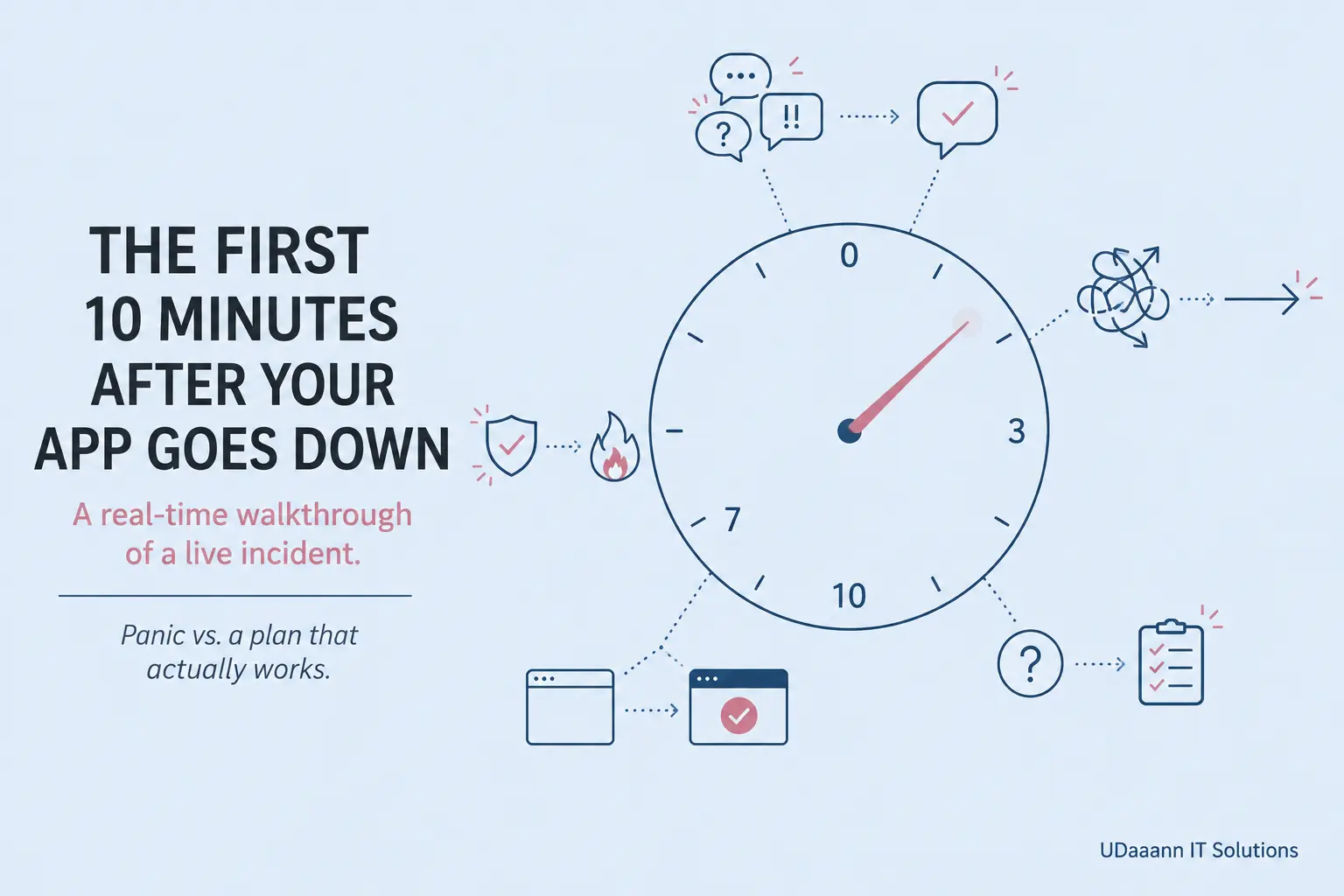
A real-time walkthrough of a live incident, and what good response actually looks like versus panic.
00:00 The Alert
It's 2:47 PM on a Tuesday. Someone is mid-sentence in a client call. Someone else has a coffee halfway to their mouth.
Then the phone buzzes. Then three more phones buzz. A monitoring alert has fired: API error rate above 40%. Seconds later, support tickets start trickling in. "Can't log in." "Page won't load." "Is anyone else seeing this?"
This is the moment that separates teams. Not the outage itself, because outages happen to everyone, even the biggest platforms in the world. What separates teams is what happens in the next ten minutes.
Here's what that actually looks like, minute by minute: the panicked version, and the version that actually works.
00:00–01:00 Detection
Panic mode: Someone notices the site is down because a customer emailed them. They refresh the page a few times, confused, hoping it fixes itself.
Good response: Automated monitoring catches the spike before a single customer complains. An alert routes instantly to the on-call engineer through a dedicated channel, not buried in email. The moment of detection is already logged with a timestamp, because in an incident, time is data.
The difference here isn't luck. It's whether monitoring was set up before the fire started.
01:00–03:00 Acknowledge and Assemble
Panic mode: Five people independently start investigating the same logs, stepping on each other, posting conflicting theories in a group chat that's scrolling too fast to follow.
Good response: One person acknowledges the alert and becomes the incident commander, not necessarily the most senior engineer, just the one steering the room. A dedicated incident channel opens. Roles get assigned fast: one person investigates, one person communicates, one person watches metrics. Nobody duplicates work because everyone knows their lane.
This is the part most companies skip, not because they don't care, but because they've never rehearsed it. Good incident response isn't improvised. It's a drill that's been run before, so when it's real, nobody's inventing the process live.
03:00–05:00 Triage, Not Theories
Panic mode: Someone guesses it's the database. Someone else swears it's the new deploy from this morning. A third person starts rolling back changes at random, hoping something sticks.
Good response: The team checks the boring, obvious things first: deploy history, infrastructure status, recent config changes, before chasing exotic theories. Dashboards for traffic, error rates, and latency are pulled up side by side. The question isn't "what's the most interesting explanation." It's "what changed right before this started."
Nine times out of ten, the cause is something recent and identifiable, not a mystery.
05:00–07:00 Communicate, Even Without Answers
Panic mode: Silence. No status page update. Customers are refreshing a broken app and hearing nothing, which is worse than the outage itself. It reads as "nobody's even looking."
Good response: A status update goes out within minutes, even if it just says: "We're aware of an issue affecting login and are investigating. Updates every 15 minutes." It doesn't need to have the answer. It needs to show the lights are on.
This single step is the cheapest, highest-impact thing a company can do during an incident, and it's the one most often forgotten under pressure.
07:00–09:00 Contain, Then Fix
Panic mode: A rushed fix gets pushed straight to production with no one else reviewing it, in a hurry to make the alert stop.
Good response: If the cause is a bad deploy, the instinct is to roll back first, debug later: restore service, then find the root cause once things are stable. Mitigation and permanent fix are treated as two different steps, not one rushed hero move.
Fast doesn't mean reckless. The best responders are calm precisely because they're not trying to be heroes. They're following a plan.
09:00–10:00 Stabilize and Confirm
Panic mode: Someone declares "it's fixed" based on a single successful page refresh, and everyone moves on, only for the issue to resurface twenty minutes later.
Good response: Metrics are watched for several minutes of sustained normal behavior before anyone calls it resolved. A second update goes out to customers. And critically, someone is already taking notes for the post-incident review, because the real fix isn't just restoring service. It's making sure this exact failure can't happen the same way twice.
The Real Difference
Look back at those ten minutes. The technical problem in both scenarios might be identical: a bad deploy, an overloaded database, a misconfigured cache. What's different is preparation. Monitoring that catches problems early, a clear chain of command, a habit of communicating before you have all the answers, and a bias toward stabilizing first and diagnosing second.
None of that is about being a genius under pressure. It's about not needing to be one, because the hard decisions were already made calmly, in advance.
How UDaaann IT Solutions Approaches This
At UDaaann IT Solutions, we treat incident response the same way pilots treat emergency checklists: not as something you improvise when it matters most, but as something you rehearse until it's boring.
Here's how we help businesses avoid becoming the panic-mode story above.
1. We build monitoring that catches problems before your customers do
Real-time alerting on the metrics that actually matter: error rates, latency, uptime, tuned to your system, not generic thresholds that either miss real issues or cry wolf constantly.
2. We design an incident response plan before you need one
Clear roles, a defined chain of command, and communication templates ready to go, so when something breaks, your team already knows exactly what to do in the first sixty seconds, without a single argument about who's in charge.
3. We help you communicate like a company customers trust
A pre-built status page and messaging framework, so your customers hear from you first, not the other way around. Transparency during downtime builds more trust than a perfect uptime record ever could.
4. We fix root causes, not just symptoms
After every incident, we run a blameless post-mortem: what happened, why, and what changes, in infrastructure, process, or code, will make sure it doesn't happen the same way again.
5. We stress-test before reality does
Through planned failure drills and infrastructure audits, we find the weak points in your systems on a Tuesday afternoon with no customers watching, not during a real outage with everyone watching.
The Bottom Line
Every app goes down eventually. That's not a failure of engineering, it's the cost of building anything real. What determines whether an outage becomes a five-minute blip or a five-star reputational disaster isn't the failure itself. It's whether your team has already answered the question: "What do we do in the first ten minutes?"
If you don't have a confident answer to that question, that's the gap worth closing, before the next alert fires, not after.
Want to find out how ready your systems actually are?
Get in touch with UDaaann IT Solutions for an infrastructure and incident-readiness review.