
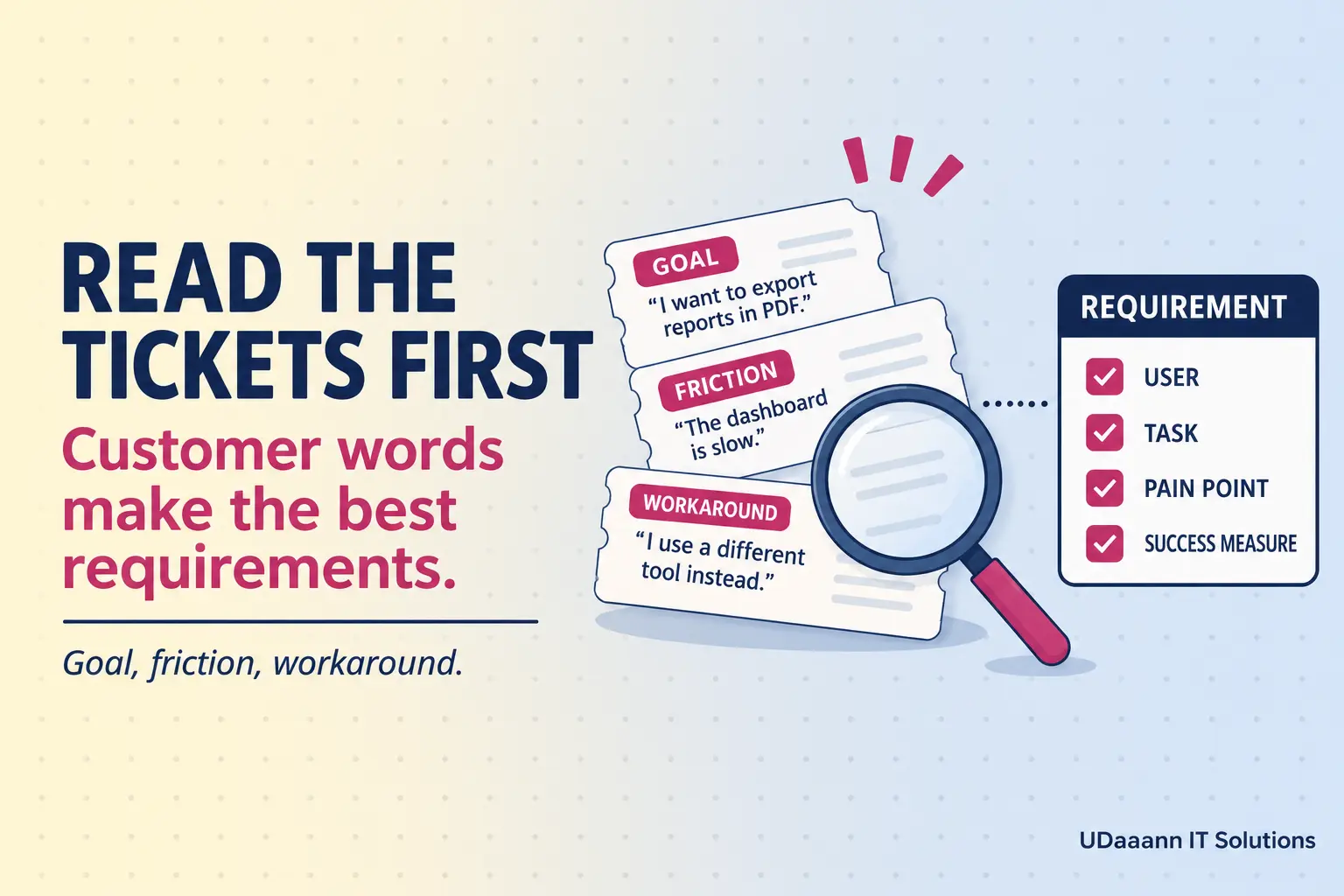
Most requirement documents are written by people who are not the customers. They come from meetings, strategy decks, or a competitor's feature list. The result reads well and often describes a product nobody asked for in that exact form.
Support tickets tell a different story. They are written at the moment someone is stuck, and they describe problems in the customer's own words. Before we draft requirements for an existing product, we read them.
What a Ticket Reveals
"I tried to export my orders and it only showed last week" contains more information than a slide that says "improve reporting." It points to a specific filter, a specific default, and a specific user who expected something different.
Frequency matters too. One complaint is an anecdote. Forty complaints about the same screen, from different people over six months, is evidence.
Three Questions We Ask
What are people trying to do? "The button is broken" often means "I cannot finish my monthly invoice."
Where do they get stuck? Look for the step where the task stops: a form that loses data, a page that is slow on mobile, a message with no next step.
What do they work around? Workarounds are the most honest signal in any product. A weekly copy of data into a spreadsheet is a feature request already in use.
How This Changes the Build
Requirements written from tickets are smaller and sharper. They name the user, the task, the friction, and the measure of success. That makes design discussions easier and acceptance criteria clearer.
It also changes priorities. A feature that sounded exciting in a meeting may affect three customers a year. A small fix to a confusing date field may save hundreds of support contacts a month.
The Caveats
Customers who complain are only part of the user base, and quiet users who simply leave do not file tickets. We therefore pair ticket analysis with usage data, short customer interviews, and observation of real workflows where possible. Tickets show where to look. They do not replace looking.
How We Work
We treat the customer's own words as the starting point for design. Our first conversations with a client often begin with their support inbox and their team's workarounds, before anyone names a technology. The tools come later, and they are far easier to judge once the problem is described in the customer's language.
The question worth asking any product team is simple: what did your customers say last week that nobody on the roadmap has read yet?