
Every software project starts with a confident sentence. "We need a customer portal." "Let's automate invoicing." "Add AI to the support desk." Each one sounds reasonable, and most are repeated in meetings without anyone checking whether the idea solves the problem behind it.
The most expensive part of software is rarely the code. It is the time spent building the wrong version of a good idea. Experienced teams spend a small effort proving an idea is worth building before they commit to building it properly.
Why Confident Plans Hide Risk
A confident plan assumes the requester understands their own process, that users will behave the way the design suggests, and that the chosen tool will handle the edge cases. These assumptions are rarely tested before the first sprint.
When they turn out to be wrong, the team finds out in week six, when an integration fails, or in month three, when customers quietly stop using the feature. By then, changing direction is expensive, and stopping feels like failure.
What a Spike Is
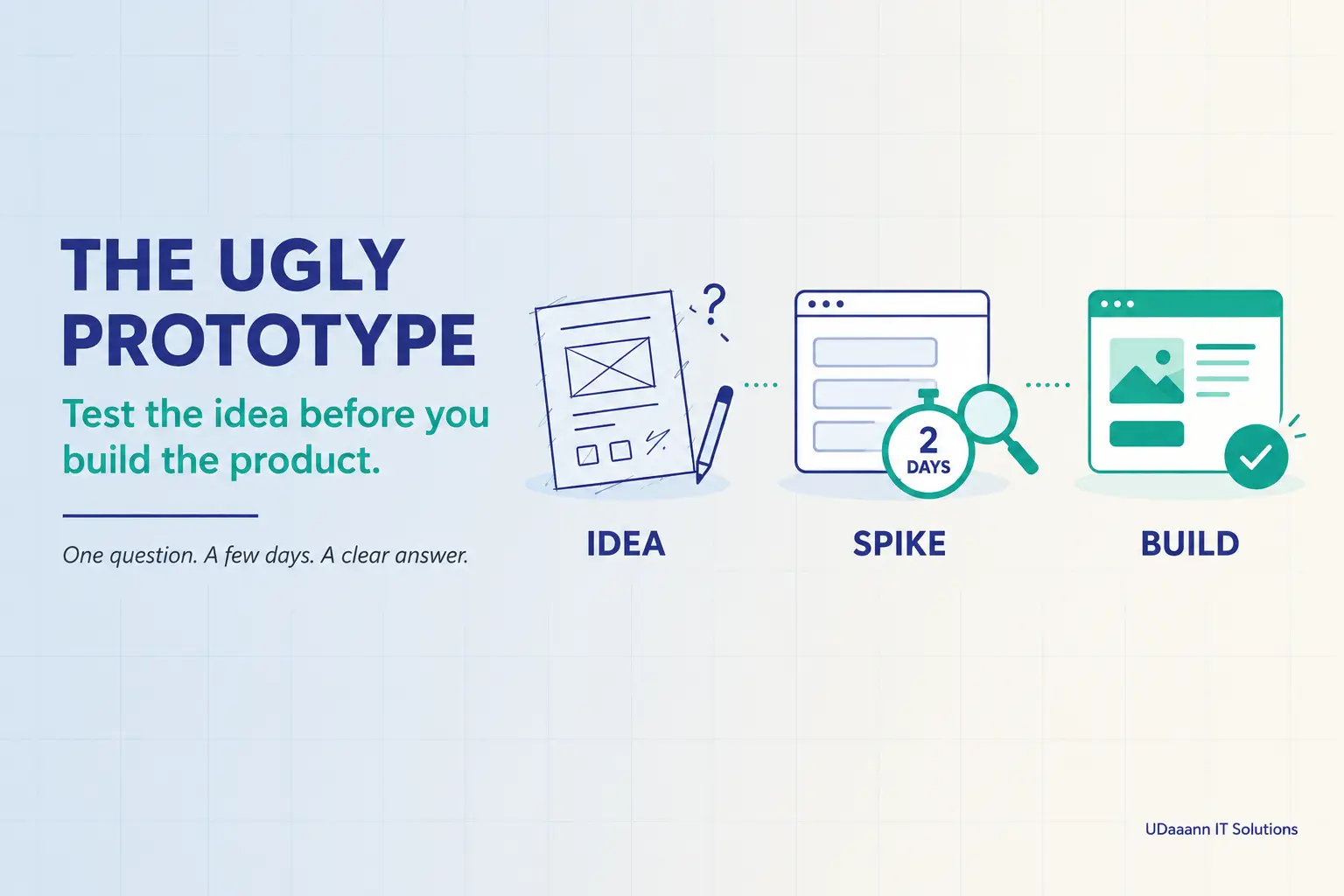
A spike is a short, time-boxed piece of work built to answer one question. It is not meant to ship. It works more like a lab experiment.
A good spike has three features:
- One question. For example: "Can order data be pulled from the supplier's system in under two seconds?"
- A time limit. Usually a few days, sometimes a single afternoon.
- A written answer. The team records what was learned, including surprises, and decides whether to proceed, change direction, or stop.
The output is knowledge. The code is often thrown away.
Why the Prototype Should Look Rough
Polished screens invite people to judge the design when the purpose is to judge the idea. A plain form with three fields tells users this is a test, and it encourages honest feedback. A finished-looking mockup often gets polite praise and then quietly gets abandoned.
Roughness also keeps the investment small. If the spike fails, the team has lost days, not months, and nobody has to defend a design they have grown attached to.
Three Questions We Ask Before Any Build
Is the problem real and frequent? We look at how often it happens and what it costs in time, errors, or lost enquiries. A problem that happens twice a year may not justify a new system.
Does the proposed solution address it? Sometimes the answer is a simpler tool, a configuration change, or a process fix. A spike shows whether the custom build is the right answer or just the most exciting one.
Can it connect to what already exists? Many projects stall because a dependency that looked simple has strict rate limits, missing data, or an approval process nobody mentioned.
What Changes With Clients
A spike moves the conversation from "what might work" to "here is a working answer to one narrow question." Disagreements become specific, and decisions become easier.
It also makes cost more honest. If data for a feature sits across four systems and two have no export, the budget conversation happens before it becomes painful. Sometimes the spike confirms the plan. Sometimes it reveals a smaller route that delivers most of the value. And sometimes it shows the problem is not yet worth solving. All three outcomes are useful.
What Goes Wrong When Teams Skip This Step
Teams that skip spikes are rarely careless. Building feels like progress, while investigation feels like delay. The pattern we see often is a long build, a late discovery of a fundamental problem, and a hard conversation about changing direction halfway through.
The cost is not only money. It is also the trust between a client and a development partner, which erodes when expectations keep shifting.
How We Work
At UDaaann IT Solutions, we treat the early stage of a project as a period of learning, not commitment. We would rather spend a few focused days answering the right question than months building a confident answer to the wrong one.
The question worth asking before any build is simple: what is the smallest thing we could make that would prove or disprove this idea? If the answer is obvious, build it. If it is not, that uncertainty is the most valuable thing you have learned all week.
Working on an idea that feels promising but not yet certain? A short, focused spike is often the best first step. We are happy to talk through what it would look like for your project.