
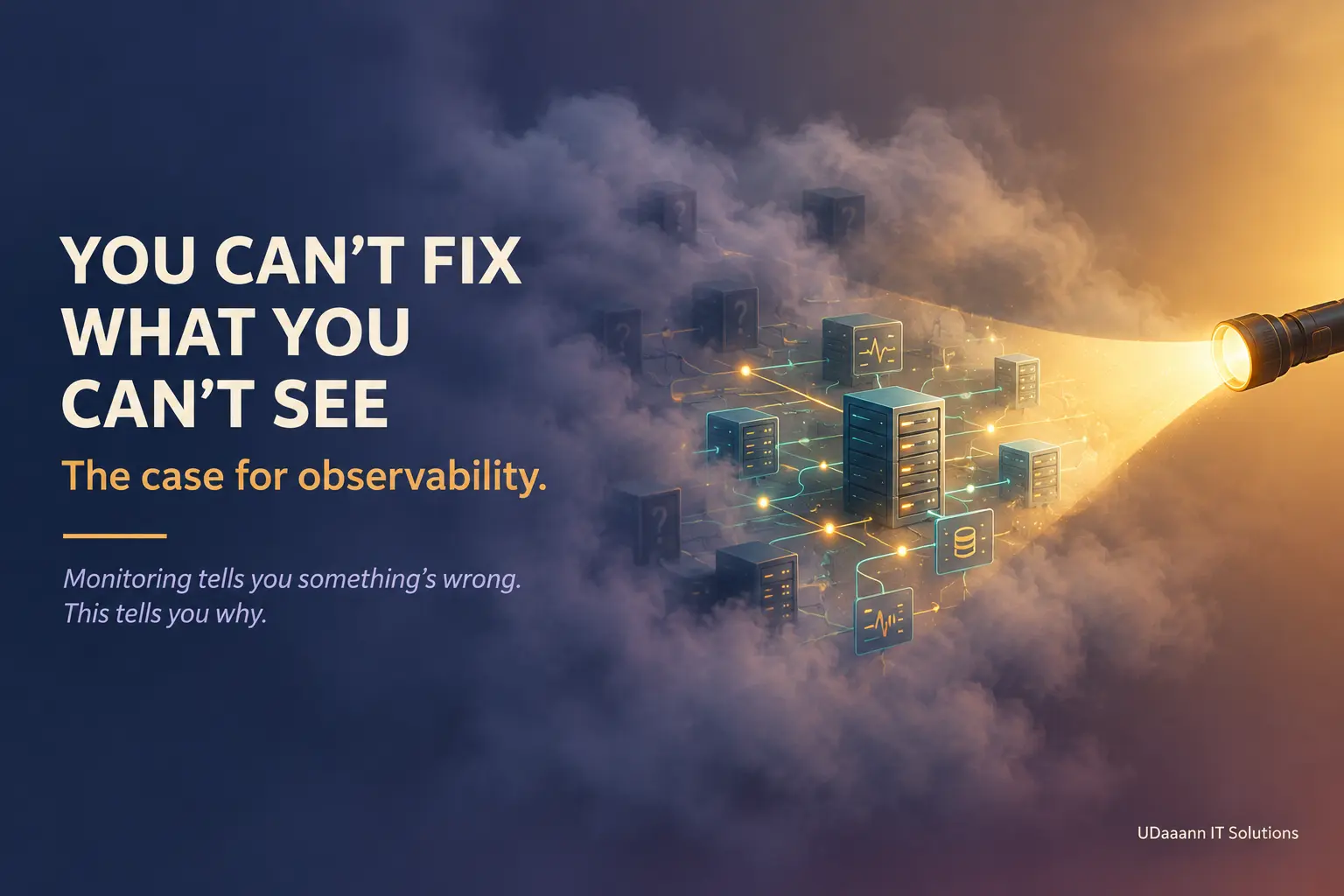
Every solutions-based technology company eventually runs into the same uncomfortable question, usually at the worst possible moment: something's gone wrong, a customer noticed before anyone internally did, and the honest answer to "what's actually happening right now" is a shrug. Not because the team is careless. Because the system was never built to answer that question in the first place.
This is the gap observability is meant to close, and it's one of the more consequential, least glamorous investments a growing software operation can make.
What Observability Actually Means, Beyond the Buzzword
Observability gets used loosely enough that it's worth defining precisely. It's not the same as monitoring, though the two are related. Monitoring tells you whether a known metric has crossed a known threshold, is response time too slow, is the error rate too high. Observability goes further: it's the capacity to ask a question you didn't anticipate in advance and get a real answer from the system itself, based on the data it's already producing, rather than needing to guess, reproduce the issue, or add new logging after the fact and wait for it to happen again.
The practical difference shows up exactly when it matters most. A monitored system can tell you that something is wrong. An observable system can tell you why, without anyone needing to have predicted that specific failure mode in advance.
Why This Has Become More Urgent, Not Less
A few converging shifts in how software gets built have made this gap more costly than it used to be.
Systems are more distributed than ever. A single user action might now touch several services, third-party APIs, background jobs, and data stores, each capable of failing independently. Without proper observability, tracing a problem through that chain by hand is slow, error-prone, and often incomplete.
AI-assisted development has increased the pace of change. Code ships faster now, which is genuinely valuable, but it also means more surface area changing more frequently, with less time for any single change to be thoroughly understood in isolation before the next one lands on top of it. Observability becomes the safety net that makes fast iteration survivable rather than reckless.
Automated and AI-driven processes generate less predictable load and behavior than human users do. An automated workflow or an agent making rapid, repeated calls against a system doesn't fail the way a person does, gradually, with visible frustration. It fails suddenly, at scale, and often silently, unless something is specifically watching for it.
Customer tolerance for unexplained downtime has dropped. Businesses that used to accept "we're looking into it" as a sufficient answer increasingly expect specificity, what happened, when it started, when it'll be resolved. Providing that requires actually knowing, not estimating.
What Genuine Observability Requires
Real observability rests on a small number of concrete practices, not a single tool purchase.
Structured, contextual logging, not just error messages, but logs that capture enough surrounding context (what request, what user, what state) to reconstruct what actually happened, without needing to reproduce it live.
Distributed tracing, so a single action can be followed across every service and system it touches, rather than investigated as a series of disconnected, isolated incidents in different places.
Metrics that reflect what users actually experience, not just what's convenient to measure. Server response time is useful. What a real user perceived as the app "hanging" is the metric that actually matters, and the two aren't always the same number.
Alerting tuned for signal, not noise. An observability setup that fires constant, low-value alerts trains a team to ignore it, which defeats the entire purpose. Fewer, meaningful alerts consistently outperform comprehensive but noisy ones.
The Cost of Treating This as Optional
Observability rarely gets prioritized proactively, because its absence isn't visible until precisely the moment it's needed. A system without it can run for a long time looking perfectly fine, right up until an incident occurs that takes hours to diagnose instead of minutes, because nobody built the capability to ask the right questions of the system while it was actually happening.
That cost compounds with scale. A small system with a handful of users can often be debugged through educated guessing and manual investigation. A growing system, handling real transaction volume, integrated with multiple third parties, increasingly touched by automated processes, cannot. The businesses that get hurt worst by this gap are consistently the ones that grew fastest without ever revisiting the assumption that manual investigation would still be good enough.
How We Approach This
We treat observability as an architectural decision made at the start of a project, not a feature added after a difficult incident makes the gap undeniable. That means structured logging and tracing get built in as systems are developed, not retrofitted. It means alerting thresholds get set deliberately, calibrated against real usage patterns rather than arbitrary defaults, and revisited as a system's traffic and behavior evolve. And it means the question "how would we actually diagnose this if it broke" gets asked during design, not during the incident itself.
This is unglamorous work. It rarely produces a feature worth demoing. Its value is almost entirely counterfactual, measured by the incidents that got resolved in minutes instead of hours, and the ones that got caught before a customer ever noticed at all.
The Bottom Line
Every solutions-based technology company eventually faces a moment where something breaks and the real question isn't whether it can be fixed, it's how quickly the cause can actually be found. Observability is what determines the answer. Businesses that invest in it before they need it treat that moment as a routine diagnostic exercise. Businesses that don't treat it as a genuine crisis, every time, indefinitely.
At UDaaann IT Solutions, we build for the first outcome as a default, not an upgrade.