
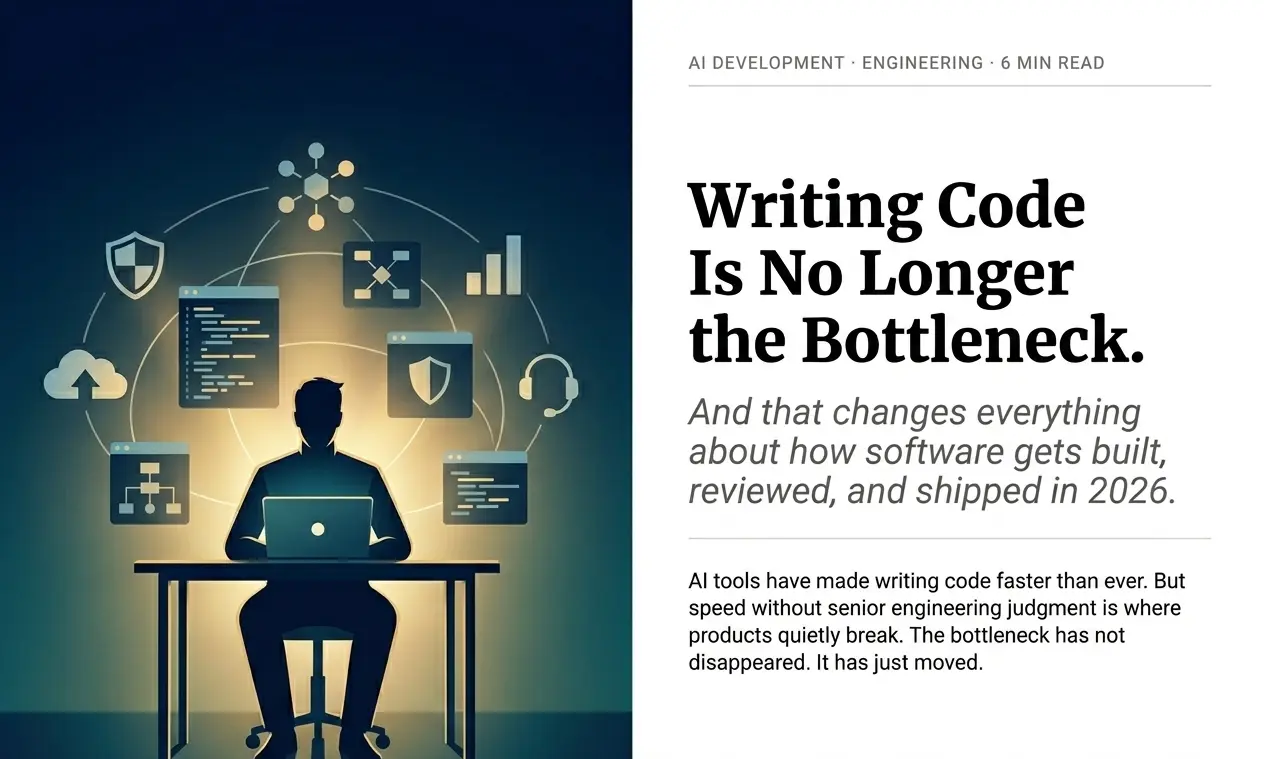
In 2026, a developer with the right AI tools can accomplish in an afternoon what used to take a full sprint. But here is what most product founders get wrong about this shift: they assume faster code generation means cheaper, simpler engineering.
It does not.
It means the nature of the bottleneck has changed, and if you are building a software product, that distinction matters enormously for your timeline, your costs, and the quality of what you ship.
The Daily Reality of AI-Assisted Development:
The workflow has fundamentally changed. Engineers today do not start with a blank file; they start with a conversation. Tools like Claude Code, GitHub Copilot, and Cursor have moved from autocomplete novelties to core infrastructure. A senior engineer describes the architecture, constraints, and edge cases; the AI scaffolds the implementation; the engineer reviews, refines, and catches what the model missed.
Routine CRUD logic, boilerplate APIs, unit test generation, and database schema migrations now happen in minutes, not days. Developers spend less time typing and more time thinking about system design, security boundaries, and failure modes.
For the first time in the history of software, writing code is no longer the primary constraint on how fast software gets built.
What AI-Native Development Platforms Actually Are:
Gartner named AI-Native Development Platforms one of its top strategic technology trends for 2026. These are not IDEs with autocomplete bolted on. They are platforms where AI is woven into the entire software development lifecycle: planning, coding, testing, reviewing, and deploying.
The key distinction is integration depth. A developer using an AI-native platform is not copy-pasting from a chatbot. The AI has context about the codebase, the architecture decisions, and the security posture.
When Gartner elevates something to a top strategic trend, it signals that early adopters are gaining real competitive advantage and that laggards will feel the gap within two to three years. That clock is already ticking.
Faster Code Generation Needs Better Engineers, Not Fewer:
When code generation accelerates, the review burden grows proportionally. You have more code to audit, more edge cases to consider, and more integration points to validate in the same or shorter timeframe.
Think of a factory that doubles its production line speed. You do not need fewer quality inspectors; you need faster, sharper ones.
AI-generated code is fluent. It looks correct. It often is correct for the happy path. But it tends to miss the 3 AM failure scenario, the race condition under load, the subtle security implication of how a token is handled. Catching those things requires experience and architectural judgment that AI tooling cannot replace.
The Quality and Security Gaps AI Code Introduces:
Security vulnerabilities at scale:
AI models are trained on public code, including code with CVEs and deprecated security practices. Without deliberate review, generated authentication flows and input validation logic can carry subtle flaws.
Architectural drift:
When AI scaffolds features without deep system context, micro-decisions compound into a codebase that is hard to extend or reason about. Technical debt accrues quietly until it becomes a rewrite.
Test coverage illusions:
AI is good at generating tests that pass without meaningfully covering failure conditions. A test suite that looks comprehensive can still miss the scenarios that matter most in production.
Over-reliance without understanding:
Developers who lean on AI generation without fully understanding the output lose the ability to debug it confidently, creating fragility that surfaces at the worst moments.
What This Means for Your Timeline and Cost:
AI-native development can dramatically compress timelines, but only when the engineering team knows how to use it correctly.
- Initial feature scaffolding, boilerplate implementation, and test generation get faster
- A well-specified feature that previously took two weeks can reach a reviewable prototype in two to three days
Architecture decisions, security reviews, integration complexity, and debugging novel production issues do not get faster. These require human expertise and cannot be meaningfully rushed.
The cost equation changes shape: you may need fewer hours for raw implementation, but you need higher-quality hours for review and architecture. Cutting corners on senior engineering oversight is the mistake most likely to create expensive problems later.
How UDaaann IT Solutions Leverages AI While Keeping Human Engineering at the Core:
At UDaaann IT Solutions, AI-assisted tooling is deeply embedded in how we write and review code, but it is paired with senior engineering judgment at every decision point that matters.
Our engineers use AI tools to accelerate scaffolding, generate test coverage, and move faster on implementation. Architectural decisions, security reviews, and integration design remain human-led. We treat AI output as a well-informed first draft that still requires experienced eyes.
The result for our clients: enterprise-grade development velocity at a cost structure that makes sense for growth-stage companies. We are not cutting corners on the things that protect the integrity of your product. We are eliminating the waste that inflated timelines without adding value.
When you work with UDaaann IT Solutions, you are not getting AI-generated code shipped out the door. You are getting a team that knows how to use every tool available to build something that holds up.
Building a product and want to understand how modern engineering fits your timeline and budget? Talk to the UDaaann IT Solutions team.