
Most conversations about outsourcing begin with the clock. How many hours apart are we? Will the calls be painful? Will we ever meet the team in person? These are reasonable questions, and they are almost never the ones that decide whether a project succeeds.
Over the years of working with clients across India and beyond, a pattern has become hard to ignore. Geography is rarely the point where things go wrong. The real failures happen in quieter places: a decision that nobody clearly owned, feedback that arrived three weeks too late, or a partner who agreed to everything on the sales call and then quietly disappeared into the backlog. Distance does not cause these problems. It simply makes weak habits easier to see.
This article looks at what actually matters when you hire a development partner who is not in the same room, and how AI is changing the way that partnership delivers.
Why Distance Gets the Blame It Does Not Deserve
Consider how a typical struggling project looks from the inside. A requirement was agreed in a call, but nobody wrote it down. Two people believed they owned the same decision. A demo was scheduled for "next week" and then moved twice. By the time anyone noticed the drift, the team had built the wrong thing, and the time zone became a convenient explanation.
Now picture a project that runs smoothly across the same distance. Decisions are recorded in a shared space. Progress is visible on a board that both sides check. A short written update goes out every day. Problems surface early because the process is built to surface them. The partner is no less distant, but the work feels close, because the habits bring it close.
The lesson is uncomfortable but useful. A team that records its decisions and reviews progress weekly is not meaningfully slower across a border. A team without those habits struggles even when everyone shares a building.
What Strong Remote Partnership Looks Like
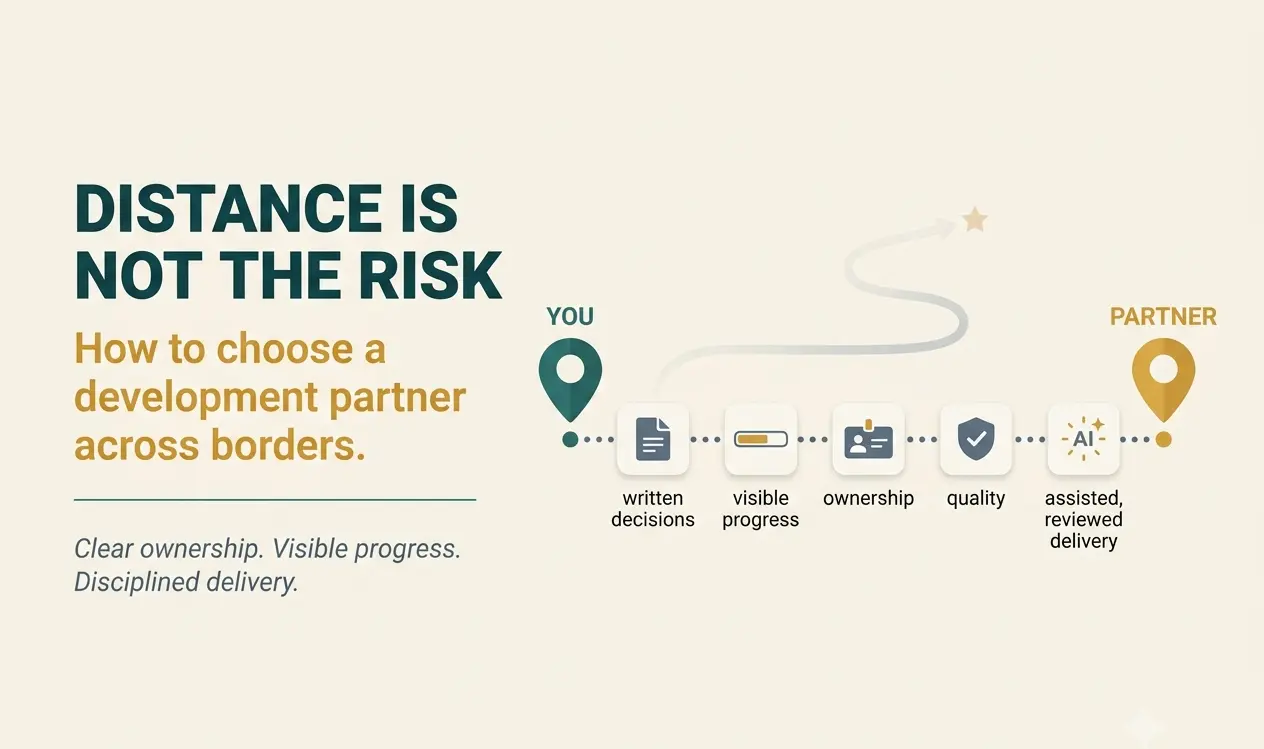
Four habits separate a dependable overseas partner from an unreliable one. None of them are exotic, and all of them can be checked before you sign.
Decisions are written down. Every scope change, trade-off, and approval lives in a shared record that both sides can read. Nothing important should depend on what someone remembers from a phone call. When a decision is disputed later, the written record settles it quickly and fairly.
Progress is visible without a meeting. A shared board, a clear demo cadence, and a standing weekly review mean you can see where the project stands without chasing anyone. Visibility is not a favour a partner grants you. It is a basic part of working responsibly on someone else's product.
Ownership is named. Each part of the work has one accountable person on each side. When a question arises, you know exactly who answers it, and the answer does not depend on who happens to be online that day.
Quality is built into the process. Automated tests, peer review of every change, and staged releases keep the work trustworthy, whether the team is ten minutes away or ten time zones away. Quality that depends on one person being careful is fragile. Quality that is part of the pipeline is durable.
Where AI Changes the Picture
AI tools have made development faster, particularly for drafting code, writing test scaffolding, and summarizing requirements. That speed is genuinely useful. It also changes where the risk sits. When output arrives faster, a careful, accountable reviewer matters more, not less. Speed without review is simply a faster way to accumulate problems nobody understands.
At UDaaann IT Solutions, we use AI assistance to accelerate the parts of delivery that benefit from it: first drafts of routine code, test scaffolding, documentation summaries, and routine refactoring. Every change still passes human review, automated checks, and the same release discipline we apply to all other work. The practical effect is a shorter path from idea to a working version, without quietly accepting code that no engineer has read closely.
The principle we hold to is simple. AI helps us build faster. It does not decide what should be built, and it does not approve what ships. Those decisions stay with people who are accountable for the outcome.
Five Questions to Ask Before You Sign
Whether a partner is down the road or across the world, these questions reveal far more than a polished proposal does.
1. Who owns the decisions on your side, and who owns them on ours? If the answer is vague or changes depending on who you ask, expect delays and confusion later.
2. How do you record scope changes? Look for a written, shared process, not a verbal agreement or a line buried in an email thread.
3. How will I see progress between milestones? A partner who cannot show work in progress either has no process or is not comfortable showing you what is happening.
4. How do you use AI in your delivery, and how is that work reviewed? You want speed with accountability. Ask who reads the output and what checks it passes before release.
5. What happens after launch? The best partners plan documentation, support, and handover before the first line of code, because the product will need care long after the project ends.
A clear, specific answer to each of these usually means the hard parts have already been thought through. A vague answer is worth paying attention to, even if everything else in the proposal looks impressive.
The Decision That Clears the Other Roadblocks
Almost every project faces a long list of obstacles: unclear requirements, tight budgets, competing priorities, integration headaches, and pressure around the launch date. Trying to solve all of them at once is exhausting, and it rarely works.
In practice, one decision makes more difference than any other: the choice of partner. A partner with clear communication, honest estimates, and disciplined delivery takes many of those obstacles off your plate before they become problems. The requirements get tested against reality sooner. The budget gets discussed in terms of trade-offs rather than surprises. The launch gets planned with a rollback option instead of hope.
For that reason, the time spent choosing a partner is not overhead. It is the highest-leverage work in the whole project.
How We Work With Clients Across Distance
At UDaaann IT Solutions, we make the working relationship explicit from the very first conversation. Decisions are written down. Progress is visible. Ownership is named on both sides. Quality is built into every release, and AI is used to speed up the work without replacing the judgement that keeps it sound.
Distance is a logistics question, and it has practical answers: good scheduling, good documentation, and good tools. Commitment is a different matter. It is a choice we make every day, on every project, regardless of where the client is sitting when they read this.
If you are weighing an overseas partner right now, start with the five questions above. And if you would like a candid conversation about how we would approach your project, we are glad to have it.
Thinking about a development partner for a project you have in mind? Reach out for an honest conversation about how we would approach it.