
There's a meaningful difference between software that works and software that's actually ready for enterprise use, and that difference rarely shows up in a first demo. It shows up six months later, when traffic has grown, when a new regulation requires an audit trail, when a team member who wrote critical code has moved on, or when a deployment needs to happen flawlessly during a company's busiest week of the year. Enterprise-grade software isn't defined by a longer feature list. It's defined by how well a system holds up under exactly those conditions.
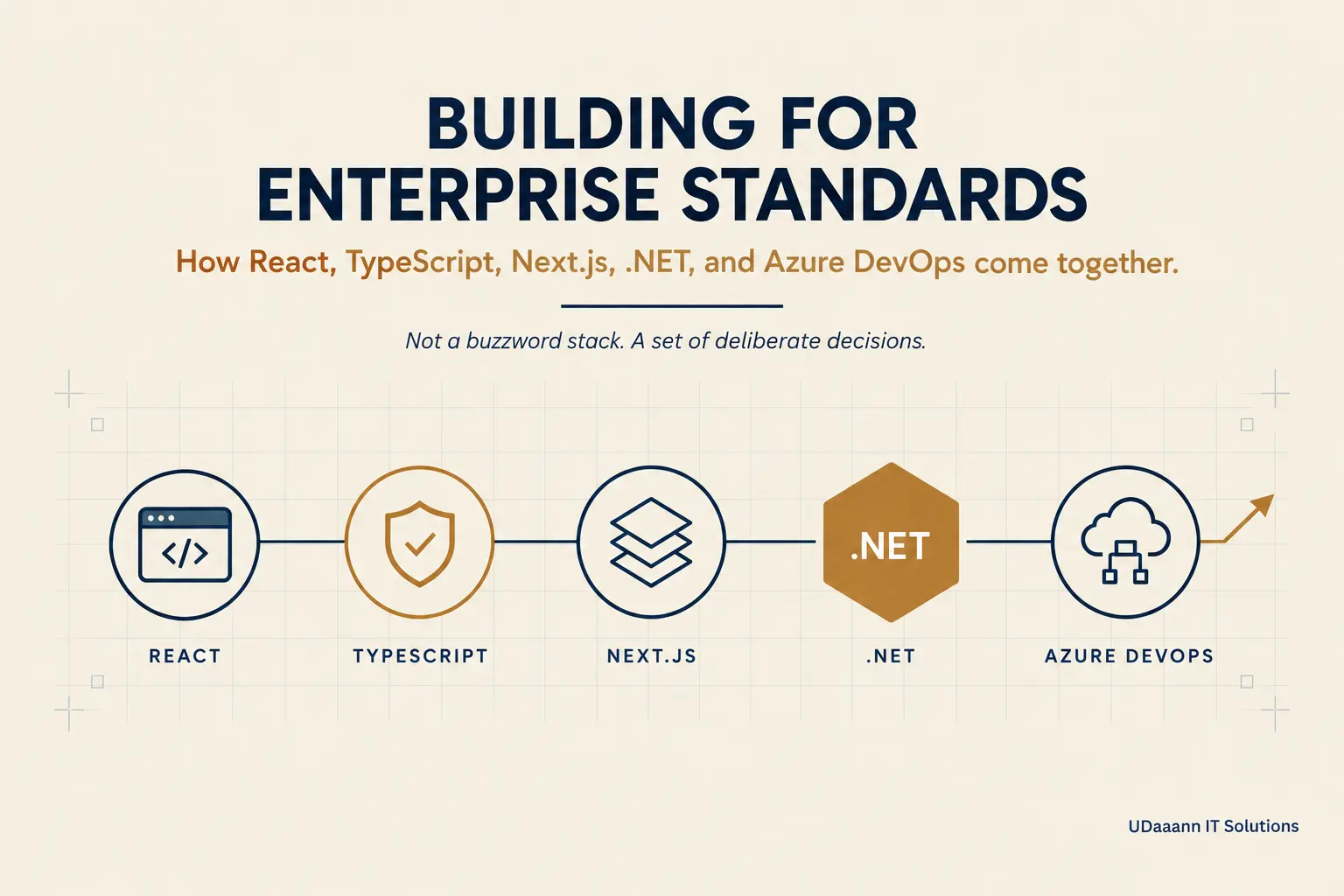
We want to walk through the specific stack we use to build toward that standard, not as a list of technology buzzwords, but as a set of deliberate engineering decisions, each addressing a real failure mode we've seen compromise otherwise well-built systems.
Why the Frontend Choice Matters More Than It Looks
React and Next.js form the foundation of how we build user interfaces, and the reasoning goes beyond developer familiarity or industry popularity.
React's component-based architecture means an interface is built from small, independently testable, independently maintainable pieces, rather than one large, tangled view that becomes harder to modify every time something new gets added. For an enterprise application, where a product's interface is expected to evolve continuously over years rather than get redesigned from scratch, that modularity is the difference between a system that accommodates change gracefully and one where every new feature risks destabilizing something unrelated.
Next.js adds a layer most teams underestimate the value of: proper server-side rendering and static generation where appropriate, meaning pages load fast and are genuinely discoverable by search engines, rather than relying entirely on client-side rendering that leaves both performance and visibility to chance. For a business-facing application, where page load speed directly affects conversion and retention, this isn't a nice-to-have. It's a measurable business outcome built directly into the framework choice.
Why TypeScript Isn't Optional for Serious Projects
TypeScript adds static typing to JavaScript, catching an entire category of errors, calling a function with the wrong type of data, accessing a property that doesn't exist, before code ever reaches a user. For a small project, this might feel like unnecessary overhead. For an enterprise application maintained by a team over years, with contributors joining and leaving the project at different points, it's closer to a safety requirement than a preference.
The practical effect compounds over time. A codebase with proper typing is genuinely safer to refactor, because the compiler itself flags breakages that would otherwise only surface at runtime, often in production, often discovered by a user rather than a developer. This matters disproportionately for enterprise software, where the cost of a production bug, in terms of trust, data integrity, or regulatory exposure, is significantly higher than in a smaller, lower-stakes application.
Why We Build the Backend on .NET
.NET gives us a mature, strongly-typed, high-performance foundation for backend systems, and its enterprise credentials aren't incidental. The framework has been refined over two decades specifically around the needs large organizations actually have: robust security primitives, genuine cross-platform deployment, strong tooling for testing and diagnostics, and performance characteristics that hold up under real, sustained load rather than just a clean benchmark.
For applications handling sensitive data, financial transactions, or workflows with real compliance requirements, .NET's maturity translates directly into fewer unknowns. The patterns for authentication, authorization, logging, and data access are well-established, extensively documented, and battle-tested across an enormous range of production systems, which meaningfully reduces the risk of a team reinventing a wheel poorly under deadline pressure.
Why the Pipeline Matters as Much as the Code
None of the above matters if the path from code to production introduces its own risk, and this is where Azure DevOps becomes a core part of how we deliver enterprise-grade software, not an operational afterthought.
A proper CI/CD pipeline means every change goes through the same automated process every time: build, automated testing, and deployment, with no step depending on a specific person remembering the right sequence of manual commands. This consistency is what actually prevents the classic "it worked on my machine" failure, since the environment that builds and tests the code is the same environment, configured identically, every single time.
Infrastructure as code extends that same consistency to the environments themselves, development, staging, and production stay aligned by definition, rather than drifting apart gradually as manual changes accumulate unevenly across them. And continuous monitoring, through tools like Application Insights, means problems get surfaced through real telemetry, response times, error rates, unusual patterns, rather than discovered through a customer complaint days after the fact.
How These Pieces Work Together in Practice
The real value of this stack isn't any single component. It's how deliberately they're designed to work together as one coherent system rather than a collection of separately chosen tools.
The frontend and backend are designed in tandem from the start, with API contracts defined before either side is built in isolation, preventing the common failure of a beautifully designed interface sitting on top of a backend that was never built to support it efficiently. TypeScript's type safety extends across that same API boundary where possible, catching integration mismatches at compile time rather than in production. And the entire pipeline, from a developer's first commit to a monitored, live deployment, follows the same automated, tested, auditable path every time, which is precisely what "enterprise-ready" actually means in practice: not a specific technology, but a system where quality and reliability are structural properties, not outcomes that depend on anyone being especially careful on a given day.
The Bottom Line
Enterprise-grade software isn't a tier of product you buy by paying more. It's a set of engineering decisions, made deliberately, about type safety, architecture, testing, and deployment discipline, that determine whether a system holds up under real growth, real regulatory scrutiny, and real operational pressure, or whether it quietly accumulates risk until something eventually breaks in a way that's expensive to fix.
At UDaaann IT Solutions, React, TypeScript, Next.js, .NET, and Azure DevOps aren't a trend-driven stack. They're the specific combination we've found actually delivers on that standard, consistently, for the businesses that need their software to be genuinely dependable, not just functional at launch.