
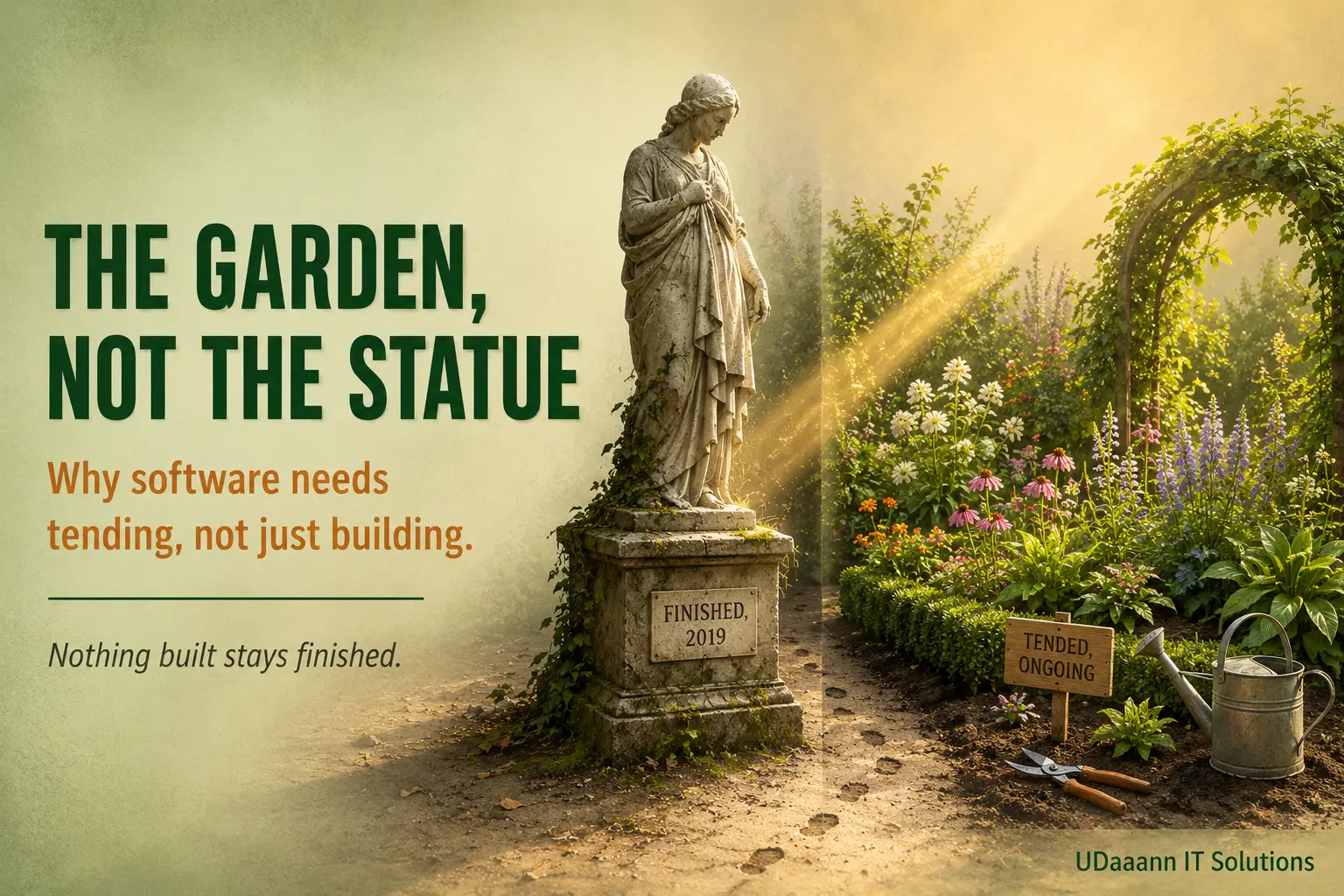
A statue is finished the day it's installed. Someone sculpts it, positions it, steps back, and that's it, the work is done. Decades later, assuming nobody vandalizes it, it looks essentially the same as the day it was unveiled. Nothing about a statue expects ongoing attention. That's the whole point of a statue.
A garden doesn't work that way. A garden that gets planted and never touched again doesn't stay beautiful, it gets overtaken by weeds, some things die from neglect, other things grow wild and start crowding out what you actually wanted there. A garden that thrives isn't one that was planted well once. It's one that gets tended, consistently, for as long as anyone wants it to keep looking good.
Most businesses treat their software like a statue. It should be treated like a garden. This distinction is quietly one of the most expensive misunderstandings in how companies think about technology.
Why the Statue Mentality Is So Tempting
It's easy to see why businesses default to thinking of software as a one-time project. A statue mindset fits a budget cleanly: pay once, get a deliverable, move on. It matches how a lot of other purchases work, buy equipment, install it, use it. And frankly, "we're done" is a satisfying thing to be able to say after a long, often stressful project.
The problem is that software isn't a physical object sitting inert in the world. It's a living system interacting with a changing environment, changing user behavior, changing business needs, changing security threats, changing regulations, changing technology underneath it. A statue doesn't need to respond to any of that. Software does, constantly, whether anyone's paying attention to it or not.
What Happens When Software Gets Treated Like a Statue
The neglect doesn't announce itself immediately, which is exactly what makes it dangerous. In the early months after launch, a statue-mentality system and a garden-mentality system look almost identical. Both work. Both serve users. Both feel, from the outside, like a finished, successful project.
The divergence happens slowly. Security vulnerabilities get discovered in the tools and libraries a system depends on, and nobody's watching for the updates that patch them. The business changes, adds a new product line, opens in a new market, and the software wasn't built to flex, because nobody expected it to need to. Small bugs that would have taken an hour to fix when they first appeared compound, because nobody was looking, into bugs that take a week to untangle once they're finally noticed. The team that built the original system moves on, and the institutional knowledge of why certain decisions were made quietly evaporates, because nothing was ever revisited enough to keep that knowledge alive.
None of this looks like a single catastrophic failure. It looks like a system that was "working fine" gradually becoming a system that's expensive, fragile, and mysterious, right up until the day something breaks badly enough that it can't be ignored anymore.
What Tending Actually Looks Like
This isn't an argument for spending indefinitely on a system with no end in sight. Gardens have deliberate, bounded maintenance, not infinite, unstructured effort. The equivalent for software is specific and manageable:
Regular, scheduled review, not just reactive fixes. A garden gets checked on a rhythm, not only when something's visibly dying. Software deserves the same, periodic review of dependencies, performance, and security, done on a schedule, not only triggered by a visible problem.
Pruning, not just adding. A healthy garden gets things removed as often as it gets things added, dead growth cleared to make room for what's actually thriving. Software benefits from the same discipline: unused features retired, outdated code cleaned up, complexity actively reduced rather than only ever accumulated.
Adapting to the actual conditions, not the original plan. A garden planted for one climate needs adjustment if conditions shift. Software built for a business at one size needs revisiting as that business genuinely changes, not forced to keep working exactly as originally designed regardless of how much the surrounding reality has moved.
Knowing which parts need more attention than others. Not every part of a garden needs the same care, some plants are hardy and low-maintenance, others need constant watching. The same is true of software: some systems are simple and stable and barely need touching, others are complex, business-critical, and deserve real, ongoing attention. Tending well means knowing the difference, not applying the same light touch everywhere.
Why This Matters More as a Business Grows
A small, simple system left untended might coast for years without serious consequence, low stakes, low complexity, low cost of eventual neglect. That math changes fast as a business grows. More users, more data, more integrations, more regulatory exposure, all of it raises the cost of an untended system quietly failing, and shortens how long neglect can go unnoticed before it becomes a real problem.
This is precisely why the businesses that get hurt worst by the statue mentality are often the ones that grew the fastest without ever revisiting that assumption. The system that was genuinely fine for a ten-person company becomes genuinely dangerous for a hundred-person one, not because anything about the code changed, but because everything around it did, while the code stayed frozen in the moment it was declared "done."
How We Actually Approach This
We build every engagement expecting the garden model, not the statue model, from the very first conversation. That shapes concrete decisions: architecture that's designed to be revisited and adjusted, not treated as a fixed, unchangeable artifact. Documentation written for someone returning to the system a year later, not just for the person building it today. Scheduled review built into the relationship from the start, not proposed awkwardly after something's already gone wrong.
It also shapes how we talk about a project's completion. Launch is a milestone, a real one, worth genuinely celebrating. It's not the finish line. The system's actual long-term success gets determined by what happens in the months and years after that, and treating that phase as an afterthought is how good, well-built software quietly becomes fragile, expensive software without anyone deciding for that to happen.
The Bottom Line
Nobody sets out to neglect their software. It happens by default, the moment a system gets treated as something you build once and walk away from, rather than something that needs the same ongoing attention as anything else genuinely alive and connected to a changing world. The businesses that get the most lasting value from their technology aren't the ones with the most impressive launch day. They're the ones who kept tending the garden long after the ribbon-cutting was over.
At UDaaann IT Solutions, that's the model we build toward from day one, because a statue looks finished. A garden actually stays alive.
Wondering whether your current systems have been tended or just left standing since launch? We're happy to take an honest look.