
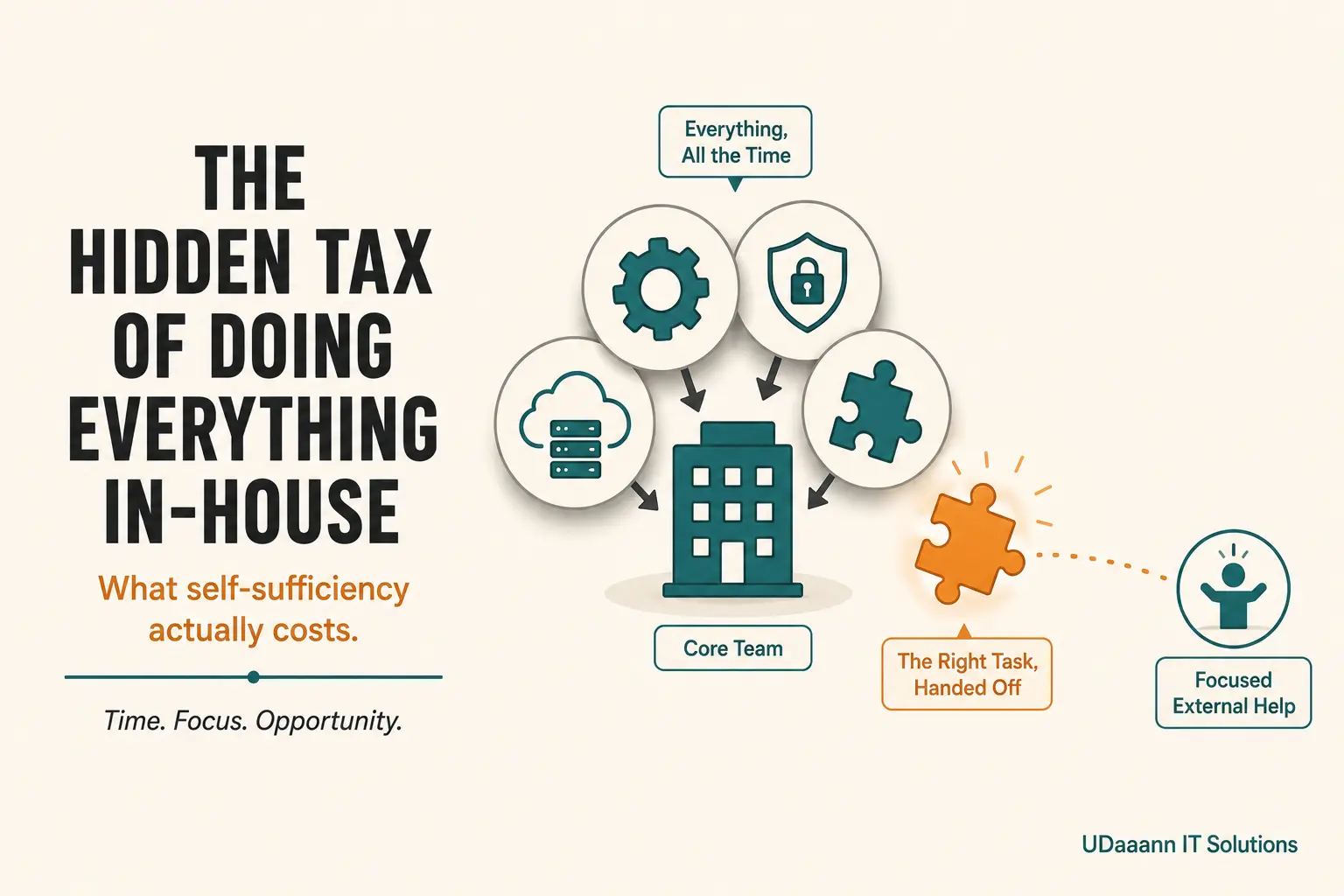
There's a version of pride that quietly costs businesses more than they realize: the belief that everything technical should be handled by the internal team, no exceptions, no outside help. It sounds like discipline. It sounds like control. Often, it's neither. It's just an unexamined tax, paid in time, focus, and missed opportunity, that nobody ever added up.
This isn't an argument against in-house teams. In-house expertise is genuinely valuable, and for a lot of core, ongoing work, it's exactly where capability should live. This is about the specific, real cost of insisting everything stays in-house, all the time, regardless of fit, and what that choice actually does to a growing business.
What the Tax Actually Looks Like
It rarely shows up as a single, obvious cost. It shows up as a pattern, small and cumulative, easy to miss until you actually look for it.
Time spent on unfamiliar territory. An in-house team that's excellent at your core product can still lose weeks to a task genuinely outside their expertise, a cloud migration, a specialized integration, a security audit, not because they aren't capable, but because doing it well the first time requires research and trial-and-error that a specialist has already done a hundred times over.
Focus pulled away from what actually matters. Every hour your core team spends untangling something outside their lane is an hour not spent on the product decisions only they can make. That opportunity cost rarely shows up on a spreadsheet, but it's real, and it compounds.
Delayed decisions because nobody's sure who owns the problem. When something falls outside anyone's clear expertise, it tends to sit in limbo longer than it should, not because people aren't trying, but because nobody's confident enough to move quickly on unfamiliar ground.
Burnout on a team stretched across too many unrelated skills. Asking a small team to be excellent at everything, product development, infrastructure, security, integrations, design, is asking a lot. Something usually gives, and it's often team morale or the quality of the core work itself.
None of this is a failure of the team. It's a structural cost of trying to be self-sufficient in areas where specialization genuinely matters.
Where This Shows Up Most Often
A few patterns come up repeatedly with growing businesses:
A capable internal developer ends up responsible for cloud infrastructure decisions they've never been specifically trained on, because there's nobody else to ask, and the business doesn't want to "bring in outsiders."
A product team delays a genuinely valuable integration for months because nobody internally has bandwidth to learn the specific API involved, even though the actual work, once scoped properly, might take a specialist a fraction of the time.
A founder personally handles security decisions because it feels irresponsible to hand off something that sensitive, even though a focused external review would likely catch more than an internal team stretched thin across a dozen other priorities.
In each case, the instinct to keep everything in-house is understandable. The cost of that instinct is just quieter than the alternative would have been.
How We Actually Fit Into This, Without Getting in the Way
We're not interested in replacing a capable internal team, and we're genuinely cautious about scope creep into places we don't belong. What we actually do is narrower and more deliberate than that.
We work around your team's existing rhythm, not against it. Before anything starts, we map out your team's current workflow and find the seams, the specific tasks or projects that are genuinely outside their focus or bandwidth, rather than parachuting in and disrupting what's already working.
We take ownership of clearly scoped pieces, not vague, ongoing control. A defined integration, a specific migration, a focused security review, work with a clear start, a clear end, and a clear handoff, so your team always knows exactly what's ours and what's theirs.
We document everything as if your team will need to pick it up tomorrow. Because eventually, they might. Nothing we build should ever feel like a black box your own people can't understand or maintain later.
We communicate on your team's schedule, not ours. Async updates, clear checkpoints, no unnecessary meetings pulling your people away from their actual work. The goal is to add capacity quietly, not add coordination overhead that eats the time we were supposed to save.
We're honest when something genuinely belongs in-house. If a task is better handled by your own team building internal capability for the long run, we'll say so, even if it means less work for us. The relationship only makes sense if it's actually solving a real bottleneck, not manufacturing dependency.
The Bottom Line
Self-sufficiency is a strength, until it becomes a reflex applied everywhere, regardless of whether it fits. The businesses that grow well aren't the ones who insist on doing everything themselves. They're the ones who know precisely which parts of the work benefit from outside expertise, and which parts should stay close to home, and who make that call deliberately instead of by default.
A Pearl Of Wisdom From UDaaann: The strongest teams aren't the ones with the widest range of skills stretched thin. They're the ones secure enough to know exactly where their edge ends, and confident enough to bring in help there without it feeling like a loss. Asking for the right help, at the right moment, in the right place, is not a gap in your capability. It's evidence of good judgment.