
There's a moment every new developer eventually has, staring at a system they've just been told is "critical," "load-bearing," or "please, whatever you do, don't touch this without asking." It's meant to be a warning. In practice, it usually just teaches them to be afraid of the thing they're supposed to be learning.
We think that fear is the wrong lesson, and it's costing teams more than anyone realizes. Here's the case for the opposite approach, and how we actually build it into how new people learn our systems.
Nobody Learns to Ride a Bike by Reading About Balance
You can explain the physics of a bicycle perfectly, center of gravity, angular momentum, the counter-steering that actually keeps you upright, and none of it will teach someone to ride. They learn by wobbling, by falling over in a driveway with padded knees, by feeling exactly what happens when they lean too far and correcting for it themselves. The explanation was never the lesson. The wobble was.
Software systems work the same way, and most teams accidentally build training programs that skip the wobble entirely. New hires read documentation, sit through walkthroughs, maybe shadow someone for a week, and then get handed access to a real, live system with an unspoken understanding that mistakes here are expensive and embarrassing. That's not training. That's asking someone to ride the bike for the first time in traffic.
Why "Just Be Careful" Doesn't Actually Work
Caution isn't a skill you can instill by asking for it. Telling someone to "be careful" with a system they don't yet understand doesn't make them more capable, it just makes them more anxious, which tends to produce exactly the kind of hesitant, second-guessing behavior that leads to the mistakes everyone was trying to avoid in the first place.
Real competence comes from a completely different place: having actually broken something, seen what broke, understood why, and fixed it, enough times that the system stops feeling like a minefield and starts feeling like a place you genuinely know your way around. You can't get there by being careful. You only get there by being wrong, safely, until you're not wrong anymore.
What "Safely" Actually Requires
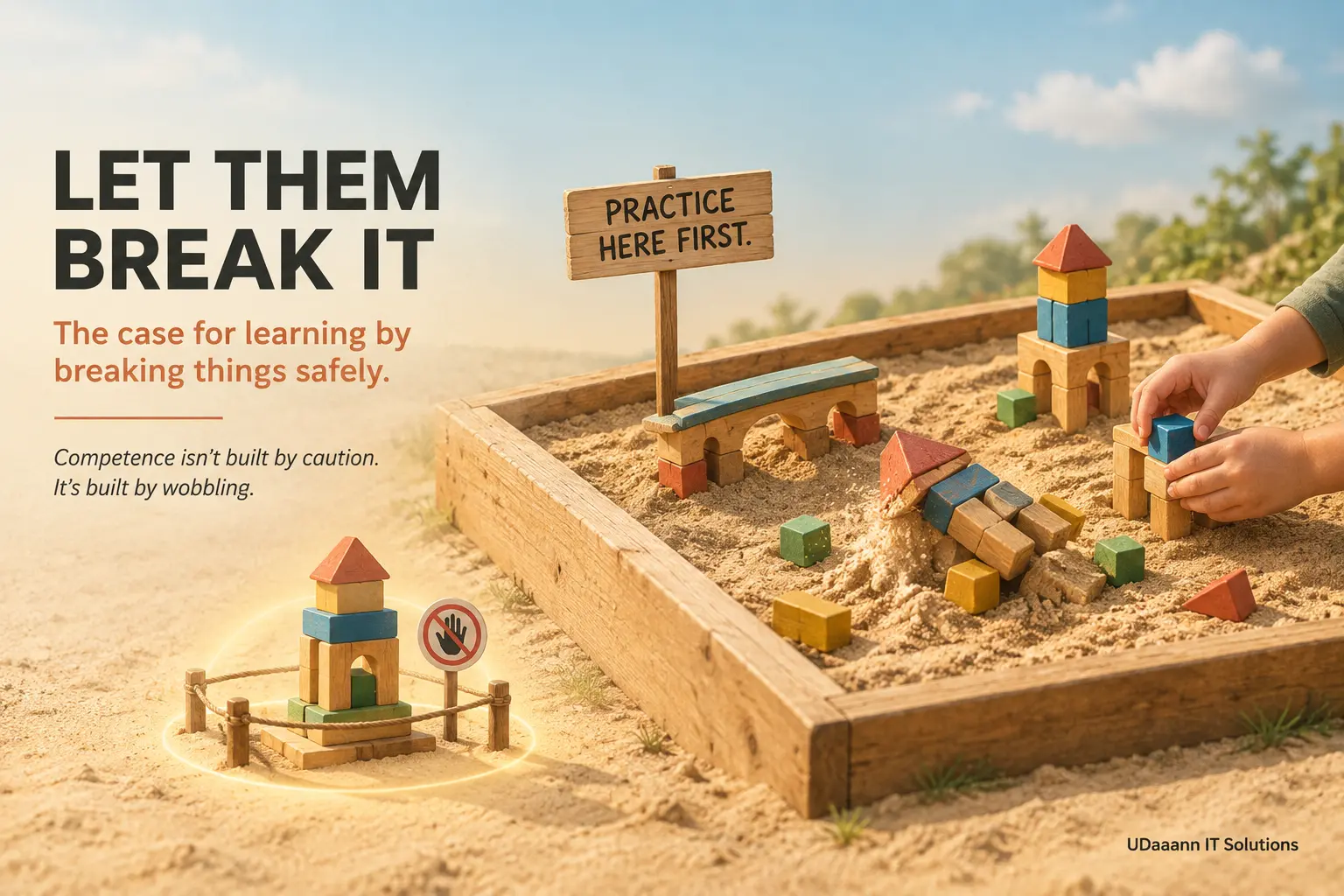
None of this works, of course, without a real answer to the obvious question: safely how? Encouraging people to experiment on production systems handling real customer data isn't bold training philosophy, it's just recklessness with better branding. The entire idea depends on building an environment where breaking something has genuinely no real-world consequence.
That means a proper sandbox, a full, realistic copy of the system, running on its own, with fake but believably messy data, disconnected from anything that actually matters. It means giving people real, unrestricted room to push, pull, and genuinely break things, not a scripted "safe" scenario that's really just a guided tour with extra steps. And it means treating the inevitable breakage not as a mistake to apologize for, but as the entire point of the exercise, the actual thing being paid for.
The Fragile Teams This Prevents
Skip this step, and you don't usually get an obvious disaster right away. You get something quieter and more corrosive: a team that's technically employed to maintain a system but genuinely afraid of it. People who route around problems instead of fixing them properly, because they've never had the chance to build real confidence in how the system actually behaves. Institutional knowledge that stays locked in the heads of the two or three people who happened to be around when the system was built, because nobody else was ever given the room to build that same understanding themselves.
That fragility doesn't show up on a org chart. It shows up months later, when the one person who actually understands a critical system goes on leave, or leaves the company entirely, and everyone else realizes they've been maintaining something they never actually learned.
How We Actually Build This In
Every new person joining a project gets a real sandbox before they get real production access, not a token afternoon of it, a genuine, standing environment they're actively encouraged to push on. We deliberately introduce realistic failure scenarios into that sandbox, not just "here's the happy path," but the messy, unexpected situations that actually happen once real users get involved.
We treat questions and mistakes in that environment as signal, not noise, if someone breaks something in the sandbox and comes to us confused about why, that's exactly the conversation the sandbox was built to create. And critically, we don't rush people out of it. Competence built under artificial time pressure tends to be shallow. We'd rather someone spend genuinely longer in a safe environment and come out the other side actually confident, than get pushed into production quickly and spend the next six months quietly, anxiously guessing.
The Bottom Line
A team that's never been allowed to break anything isn't a careful team. It's an untested one, and the difference only becomes obvious at the worst possible moment, when something actually does go wrong and nobody in the room has ever seen anything like it before. The teams that handle real incidents calmly aren't the ones who avoided every mistake along the way. They're the ones who already made plenty of them, somewhere nobody could get hurt.
At UDaaann IT Solutions, that's not a nice-to-have in how we bring people onto a project. It's the actual foundation of how we build genuine, lasting confidence in the systems we're responsible for, ours and our clients'.
Building or scaling a team that needs to genuinely understand a complex system, not just operate it cautiously? We're happy to talk through what that onboarding could actually look like.