
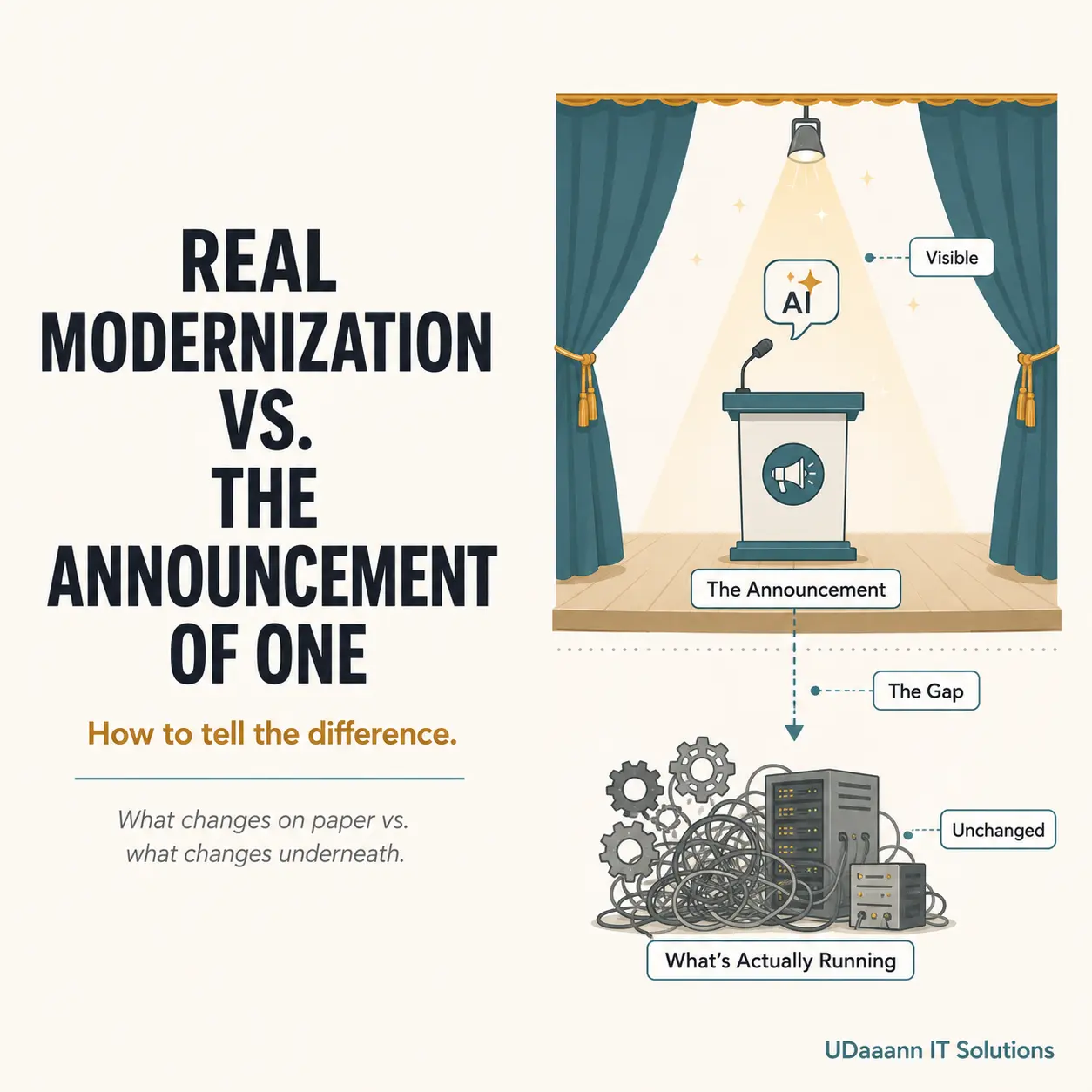
There's a specific kind of announcement that's become impossible to scroll past. A company proudly declares it has "gone digital," "embraced AI," or "modernized its stack." A press release goes out. A LinkedIn post gets written. Somewhere in a boardroom, a slide says "AI-Powered" in a large, confident font.
And then, quietly, absolutely nothing changes in how the business actually operates.
We call this Modernization Theater. It's the external-facing cousin of a pattern we've written about before, Tokenmaxxing, where teams optimize for how much AI got used internally instead of what got delivered. Modernization Theater is the same failure, aimed outward. The announcement is real. The transformation isn't.
Why This Keeps Happening:
Adopting new technology has become a signal, not just a decision. Saying "we use AI" carries weight with investors, customers, and even employees, regardless of whether that AI is doing anything meaningful. That pressure produces a predictable shortcut: bolt something visible onto the front of the business (a chatbot widget, an "AI-powered" search bar, a dashboard with a sparkle icon) while the actual workflows underneath stay exactly as they were.
The result looks modern. It doesn't behave modern.
What's Actually Changing Right Now (Beyond the Buzzwords):
To be clear, this isn't an argument that new technology is all theater. Some of it is genuinely reshaping how systems get built. It's worth separating the real shifts from the announcements built on top of them.
AI's real advantages, when it's actually integrated well:
- Faster first drafts of code, documents, and interfaces, real time saved on the parts that used to eat entire days
- Pattern detection across large datasets that would take a human analyst weeks to spot manually
- Natural language interfaces that let non-technical staff query systems without needing a developer as a middleman
- Automated handling of repetitive, rules-based work, freeing people for judgment-based work instead
AI's real limitations, the parts the press releases skip:
- It doesn't understand your business's specific edge cases unless someone has deliberately taught it to
- It can be confidently wrong in ways that are hard to catch without a human reviewer who actually knows the domain
- It adds a genuine ongoing cost (compute, monitoring, retraining) that rarely gets mentioned alongside the launch announcement
- It doesn't fix a broken process, it just makes the broken process faster
What's changing underneath the surface, in the data layer:
For years, vector databases (purpose-built systems for storing and searching AI embeddings) were the default answer for anything AI-related. That's shifting. A lot of mainstream databases, the kind businesses already run, now support vector search natively as an add-on feature rather than requiring an entirely separate specialized system. That means fewer moving parts, less duplicated data, and less operational overhead for businesses that don't need vector search at massive scale.
For businesses with genuinely large-scale, high-throughput similarity search needs, dedicated vector databases still earn their place. For most small and mid-sized businesses, the simpler, unified approach is usually the better fit, one less system to maintain, one less integration to break.
This is a useful example of the broader pattern: the newest tool isn't automatically the right tool. The right tool is the one that matches the actual scale and shape of your problem.
How to Tell If a New AI Tool Is Actually Worth Adopting:
A short, practical checklist, the kind of thing worth running before any new tool gets added to your stack:
- Does it replace a specific, named pain point, or is it a general "AI capability" with no clear job? If you can't name the exact task it improves, it's not ready to adopt yet.
- Does someone on your team understand how it fails, not just how it succeeds? Every tool has a failure mode. If nobody can describe it, nobody's actually evaluated it.
- Does it require your data to leave your systems, and if so, where does it go? A real question with real compliance and trust implications, not a footnote.
- Can you measure its impact in something other than "it feels faster"? If there's no measurable before/after, you're adopting a feeling, not a result.
- Does it still add value once the novelty wears off? A lot of tools are exciting for a month and abandoned by month three. Ask what happens at month six.
- Does it integrate with what you already have, or does it demand you rebuild around it? A tool that requires ripping out working systems needs a much higher bar of proof before it's worth the disruption.
Why This Matters More With Legacy Systems:
The businesses most exposed to Modernization Theater are usually the ones with the most legacy infrastructure underneath, older databases, custom-built internal tools, processes that have quietly run the same way for a decade. It's tempting to paper over that complexity with a flashy new layer on top. It rarely holds. New tools connected carelessly to old systems tend to break exactly where the seams are, usually at the worst possible moment, not during the demo.
Real modernization means understanding what's underneath before deciding what goes on top. That's slower. It's also the only version that actually lasts.
Where UDaaann Fits Into This:
We've spent enough time evaluating new tools, legacy systems, and every possible way they combine, badly and well, that most of this evaluation has become second nature to our team. When a new AI tool, database technology, or platform shows up, we don't need months to figure out if it's substance or theater. Our team's experience means it usually takes a glance to know what's worth building into a client's systems, what's worth watching before adopting, and what's simply not relevant to a particular business yet.
That's the difference between adopting technology because it's new, and adopting it because it's actually the right fit for where your business is and where it's headed.
Not sure if a tool you're evaluating is worth the investment, or just worth watching? We're happy to take an honest look.