
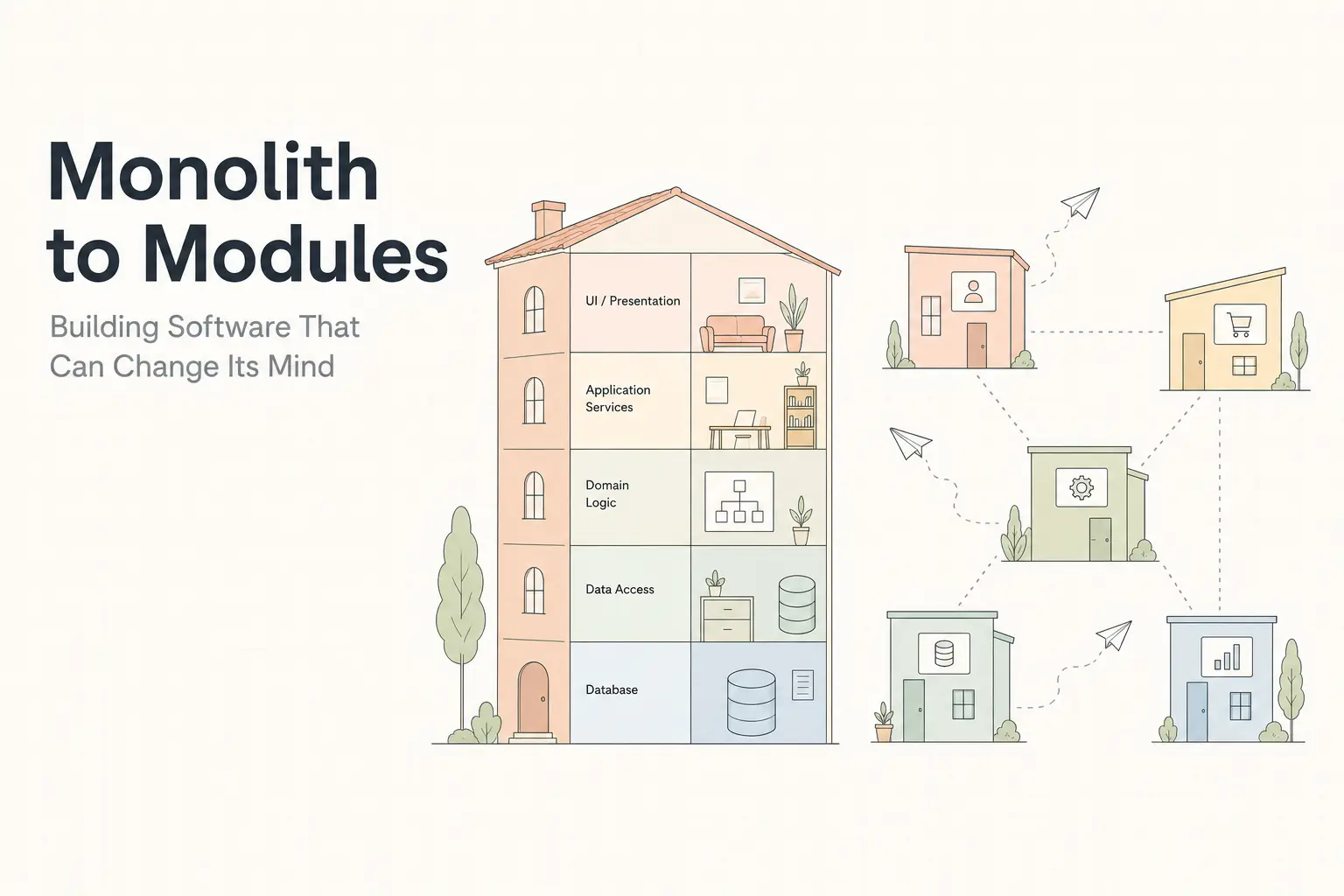
Somewhere in the last decade, "we need to break this into microservices" became a sentence business owners heard in meetings without ever being told what it meant, why it mattered, or whether it was even true.
It is one of the few technical decisions made early in a company's life that quietly decides how expensive every future decision becomes. Not because the words "monolith" or "microservices" matter to your customers. They will never see either. But the structure underneath your product determines something they absolutely will feel: how fast you can change, add, or fix things when the market asks you to.
This is not a developer conversation. It is a business strategy conversation that has been dressed up in engineering language for so long that most founders have stopped trying to follow it. Worth trying again, because the answer in 2026 is more interesting than it has been in years.
The Two Ways to Build Something
Picture your software as a building.
A monolith is one structure. Every room shares the same walls, the same foundation, the same electrical system. If you want to repaint the kitchen, you are still working inside the same building that holds the bedroom, the bathroom, and the garage. Change one wall carelessly and you might affect the whole frame.
A set of microservices is the opposite extreme. Every room is its own separate building, with its own foundation, its own electrical line, its own front door. You can renovate the kitchen without anyone touching the bedroom. But now you have five buildings to maintain, five roofs that can leak, and a courier running between them constantly to deliver things from one room to another.
Neither is "correct." Each is a trade-off, and the trade-off depends entirely on the size and shape of the business living inside it.
For years, the industry treated this as a one-way maturity ladder: small companies start as a monolith, and as they grow, breaking into microservices is the inevitable, sophisticated next step. If you hadn't made the jump, you were behind.
That belief has not aged well.
What Actually Happened to the Companies That Made the Jump Too Early
Across the last few years, a quieter story has been playing out inside a lot of engineering teams that isn't visible from the outside. Companies split their product into a dozen, sometimes dozens, of independent services, expecting the agility they'd read about. Instead, many got something else: every internal request between services now had to travel across a network instead of happening instantly inside one program, debugging a single customer issue meant tracing it across ten different systems instead of one, and the cloud bill went up because every one of those small services needed its own slice of infrastructure, monitoring, and security.
A recent industry survey found that roughly 42% of organizations that adopted microservices have since pulled at least some of those services back together into larger units, citing debugging complexity and operational overhead as the primary drivers. The pattern was consistent enough that it now has a name in engineering circles: the microservices backlash.
This is not an argument against microservices. It's a correction to a myth: that splitting things up is always progress. For a business with one product, a small team, and a market that hasn't fully validated itself yet, that split was often a cost paid years before it needed to be.
The Real Question Isn't Monolith or Microservices. It's: Can You Change Your Mind Later?
Here is the part that actually matters for a growing business, and it has nothing to do with which architecture sounds more advanced.
The real cost of bad architecture isn't slowness today. It's the price tag on tomorrow's pivot.
Say your business needs to add a new payment method, support a new region, or bolt on a feature a big client is demanding before they'll sign. In a poorly structured system, whether it's a tangled monolith or a poorly split set of microservices, that "simple addition" turns into a project that touches code no one fully understands anymore, breaks something unrelated three weeks later, and takes twice as long as anyone quoted.
In a well-structured system, that same addition is contained. It touches one module, one boundary, one piece of the building, and the rest of the structure doesn't notice.
This is what "modular" actually means, and it has almost nothing to do with whether you chose monolith or microservices on day one. It has everything to do with whether the lines between the different responsibilities in your software were drawn deliberately, or never drawn at all.
A genuinely modular monolith, one structure, but built with strict, clean boundaries between its rooms, can take a business further than a poorly-split set of microservices ever will. The industry is increasingly comfortable saying this out loud, where a few years ago it would have sounded outdated.
Where AI Has Quietly Changed the Math
Here's the part of this story that didn't exist three years ago, and it changes the calculation in a real way.
The traditional argument against starting modular and properly structured was always: it takes longer, it costs more up front, and a small team doesn't have the bandwidth to plan boundaries that carefully on day one. So businesses cut corners, planning to "fix it later," and later rarely came.
AI coding agents have started closing that gap. Tools that can read an entire codebase, understand how its pieces depend on each other, and carry out a multi-step restructuring (extracting a tangled piece of logic into its own clean module, generating the tests to prove nothing broke, updating the documentation to match) used to require a senior engineer's full attention for days. That work can now be planned and executed with significant AI assistance, with a human reviewing the result rather than typing every line of it.
This matters specifically for the monolith-versus-modules decision, because the single biggest argument against "build it modular and clean from day one" was always cost and time. AI-assisted refactoring doesn't remove that cost entirely, but it meaningfully lowers it; what once needed a dedicated sprint can now be scoped, drafted, and verified far faster, with a developer directing the work and checking it rather than doing all of it by hand.
There's a second, more strategic shift worth understanding too. A growing share of every modern product now includes some AI component, whether that's a recommendation engine, a chatbot, document processing, or anything built on a language model. These AI components tend to have very different scaling and resource needs than the rest of your application; they often benefit from being isolated into their own service, even inside a system that is otherwise a clean modular monolith. The decision is no longer purely "are we big enough for microservices." It is increasingly "does this specific piece of AI functionality need its own room, while everything else stays in the same building." That's a much more precise, much less expensive question to answer.
What This Means If You're Running the Business, Not Writing the Code
You don't need to know what a service boundary is. You do need to ask three questions before signing off on how something is built.
Can this be changed without rebuilding everything around it? If your developer's honest answer involves a long pause, that's information.
Are we splitting things up because the business genuinely needs it, or because it sounds more advanced? A surprising amount of unnecessary complexity in software gets introduced because someone wanted to build the impressive version, not the right one.
If we need to grow a specific part of this fast later, like adding an AI feature or scaling one part of the product to handle a sudden spike, can that piece be pulled out on its own without disturbing everything else? This is the modern version of "is this built to grow," and in 2026 it's a sharper question than it used to be.
None of this requires a technical degree to ask. It requires someone in the room who understands that architecture is not a developer's personal preference. It's a decision about how much your next six pivots are going to cost.
We've sat in enough of these conversations to know the pattern: the businesses that ask these questions early spend less money fixing things later, and the ones that don't usually find out the hard way, right around the time a big opportunity shows up and the software can't keep pace with it.
If you're somewhere in the middle of that conversation right now, it's worth having it properly, before the next decision gets made by default instead of on purpose.