
TL;DR — Key takeaways from this post
- Small businesses account for the majority of cyberattacks globally, yet most have no incident response plan.
- The most common entry points are not sophisticated exploits. They are unlocked doors that nobody checked.
- Security is not a one time setup. It is an ongoing practice that most small business owners treat as a completed task.
- The gap between being targeted and being prepared is not a budget problem. It is an awareness problem.
In This Post:
- Why small businesses are the primary target
- The three unlocked doors attackers use most
- What happens inside your system before you know anything is wrong
- The security assumption problem
- What basic preparedness actually looks like
- The one question every small business owner should be able to answer
- Lessons from this post
Why Small Businesses Are the Primary Target:
There is a persistent myth that cybercriminals are primarily interested in large enterprises. The logic feels sound. Big companies have more data, more money, and more to lose. But the logic ignores the economics of attack.
Large enterprises have security teams. They have monitoring systems, incident response playbooks, penetration testing schedules, and dedicated budgets for exactly this kind of threat. Getting through their defences is expensive, time consuming, and uncertain.
Small businesses have none of that.
A small business typically has one person responsible for technology decisions. That person is usually the owner, the office manager, or whoever is most comfortable around computers. Security is something they set up once when the business launched and have not thought about since.
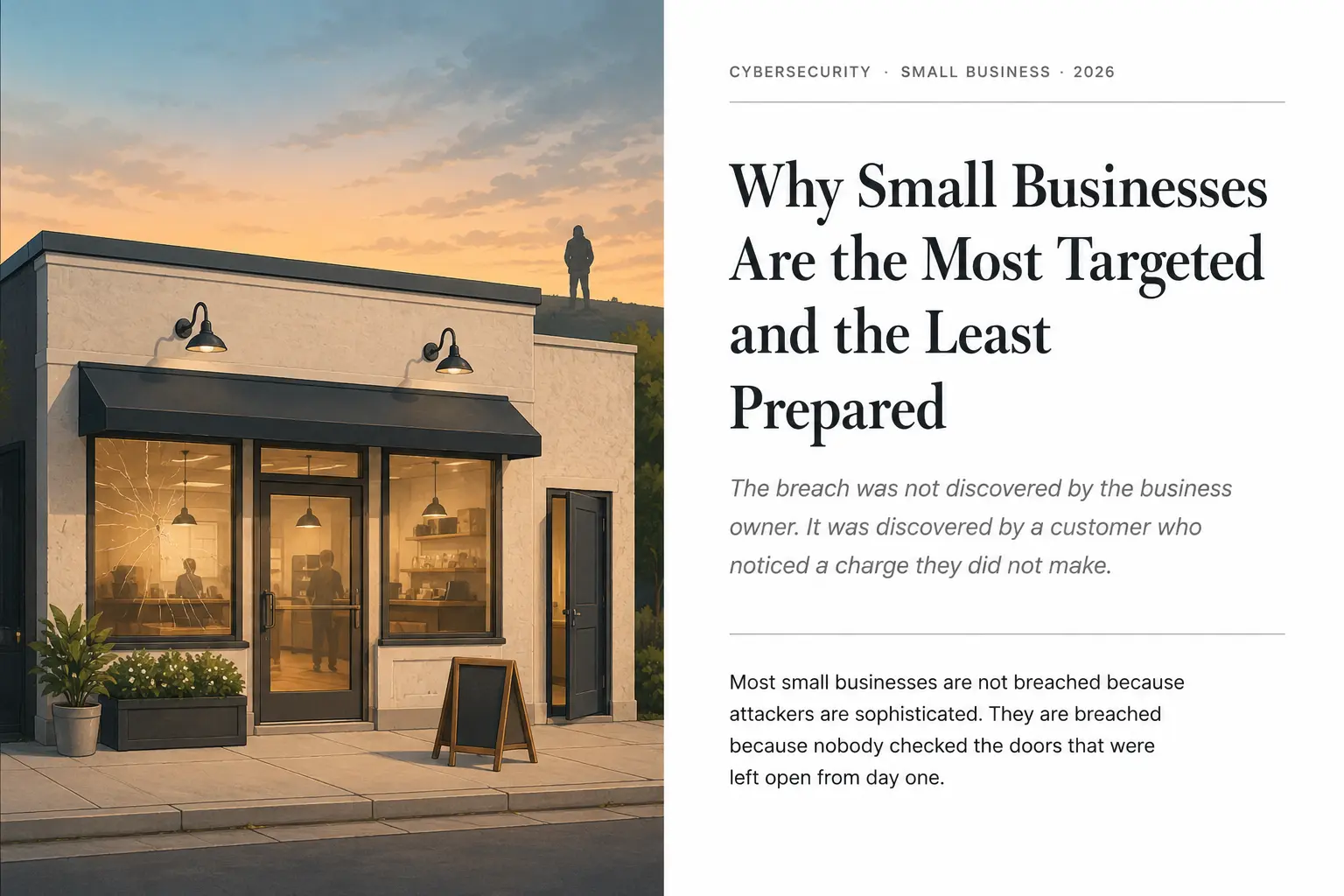
From an attacker's perspective, a small business is a door with no lock, no alarm, and no camera. The reward is smaller than an enterprise breach. But the cost of entry is a fraction of the effort. And with enough small businesses breached at scale, the economics work out very well for the attacker and very badly for everyone else.
The target is not always the most valuable. It is the most accessible.
The Three Unlocked Doors Attackers Use Most:
When we audit the security posture of small businesses, the same vulnerabilities appear repeatedly. Not because businesses are careless. Because nobody told them these were doors.
Door one —> Credentials that have never been rotated:
Passwords set at launch and never changed. Default admin credentials on software that was installed and forgotten. Former employees whose access was never revoked. Every one of these is an open invitation that most business owners do not know exists.
Door two —> Software that stopped receiving updates:
A plugin installed two years ago. A version of a CMS that the developer last touched when they built the site and has not returned to since. Unpatched software is the single most common entry point for automated attacks because the vulnerabilities are publicly documented and the tools to exploit them are freely available.
Door three —> No visibility into what is happening:
Most small businesses have no monitoring. No logs being reviewed. No alerts when unusual activity happens. An attacker can enter a system, move through it, and exfiltrate data over weeks without triggering a single notification. The breach is discovered when a customer calls. Or when a bank flags a transaction. Or when someone notices the website is behaving strangely.
By then, the window of impact is long past.
What Happens Inside Your System Before You Know Anything Is Wrong:
Understanding the timeline of a typical small business breach changes how seriously you take prevention.
The initial entry is rarely dramatic. It is a credential that matched a leaked database. It is an automated scanner that found an unpatched vulnerability and exploited it in seconds. It is a phishing email that one employee clicked while distracted.
Once inside, the attacker does not immediately do anything visible. They spend time mapping the environment. What data is here. Where it is stored. What access this account has. Whether there are other accounts with higher privileges.
Then comes the quiet extraction. Or the dormant persistence, where they install a backdoor and leave, returning later when it is useful.
The time between entry and discovery for small business breaches is measured not in hours but in weeks. Sometimes months. The damage accumulates invisibly while the business runs normally on the surface.
The most dangerous phase of a cyberattack on a small business is the part that feels like nothing is happening.
The Security Assumption Problem:
When we talk to small business owners about security, we find the same assumption at the root of almost every vulnerability.
They believe security is a state rather than a practice.
They set up a firewall. They installed antivirus software. They chose passwords that were not obviously simple. And so in their mental model, security is done. It is a completed item on a setup checklist.
Security is not done. It is never done. It is a continuous process of reviewing access, patching vulnerabilities, monitoring activity, and updating practices as threats evolve.
The businesses that understand this do not necessarily have large budgets. They have a different mental model. They treat security the way they treat accounting. Not a one time setup. A regular practice with scheduled reviews, clear ownership, and documented processes.
The businesses that do not understand this are not negligent. They are simply operating on an assumption nobody corrected.
What Basic Preparedness Actually Looks Like:
Preparedness does not require a dedicated security team or an enterprise budget. It requires four things done consistently.
Know what you have
A complete inventory of every system, tool, account, and integration your business uses. Who has access to what. When that access was last reviewed. This sounds obvious. Almost nobody has done it.
Know who has access
A current list of every person, both inside and outside the business, who has credentials to any system. Former employees. Contractors. The developer who built the website. The accountant who has login access to the financial software. Access that is not actively managed is access that is actively dangerous.
Know what normal looks like
Basic monitoring and alerting so that unusual activity triggers a notification rather than a discovery weeks later. This does not require sophisticated tooling. It requires someone to set it up and someone to look at the alerts when they fire.
Know what to do when something goes wrong
A simple incident response plan. Who gets called. What gets isolated. Who gets notified. What the legal obligations are. A plan that exists on paper and has been read by the relevant people is worth more than the most sophisticated security infrastructure with no human process behind it.
The One Question Every Small Business Owner Should Be Able to Answer
If someone has been inside your system for the past two weeks, how would you know?
Not how you hope you would know. Not how you assume you would know. How, specifically, would you know.
If that question produces a confident and specific answer, your baseline security posture is better than most.
If that question produces a pause, or a vague answer involving antivirus software, or the honest admission that you would only know when a customer told you, that pause is the entire problem in a single moment.
The answer to that question tells you everything about whether your business is prepared or whether it is simply waiting.
Lessons From This Post
1. Small businesses are primary targets not because of their value but because of their accessibility. Reducing accessibility is the most effective first step.
2. The three most common entry points are unrotated credentials, unpatched software, and absent monitoring. All three are fixable without significant budget.
3. Security is a practice not a state. A firewall installed at launch is not security. It is the beginning of a security practice that requires ongoing attention.
4. The most dangerous period of a breach is the silent one. Monitoring exists to shorten it. Every week without monitoring is a week an attacker could be inside your system undetected.
5. A basic incident response plan, documented and understood by the relevant people, is worth more than any single security tool. Know what you will do before you need to do it.
6. Ask the question now. If someone has been inside your system for the past two weeks, how would you know? The quality of your answer tells you exactly where to start.
At UDaaann IT Solutions we work with small and growing businesses to build security practices that match the real threat landscape, not the enterprise playbook scaled down. The first conversation is always about your actual situation, not a product.
Published by UDaaann IT Solutions · 2026