
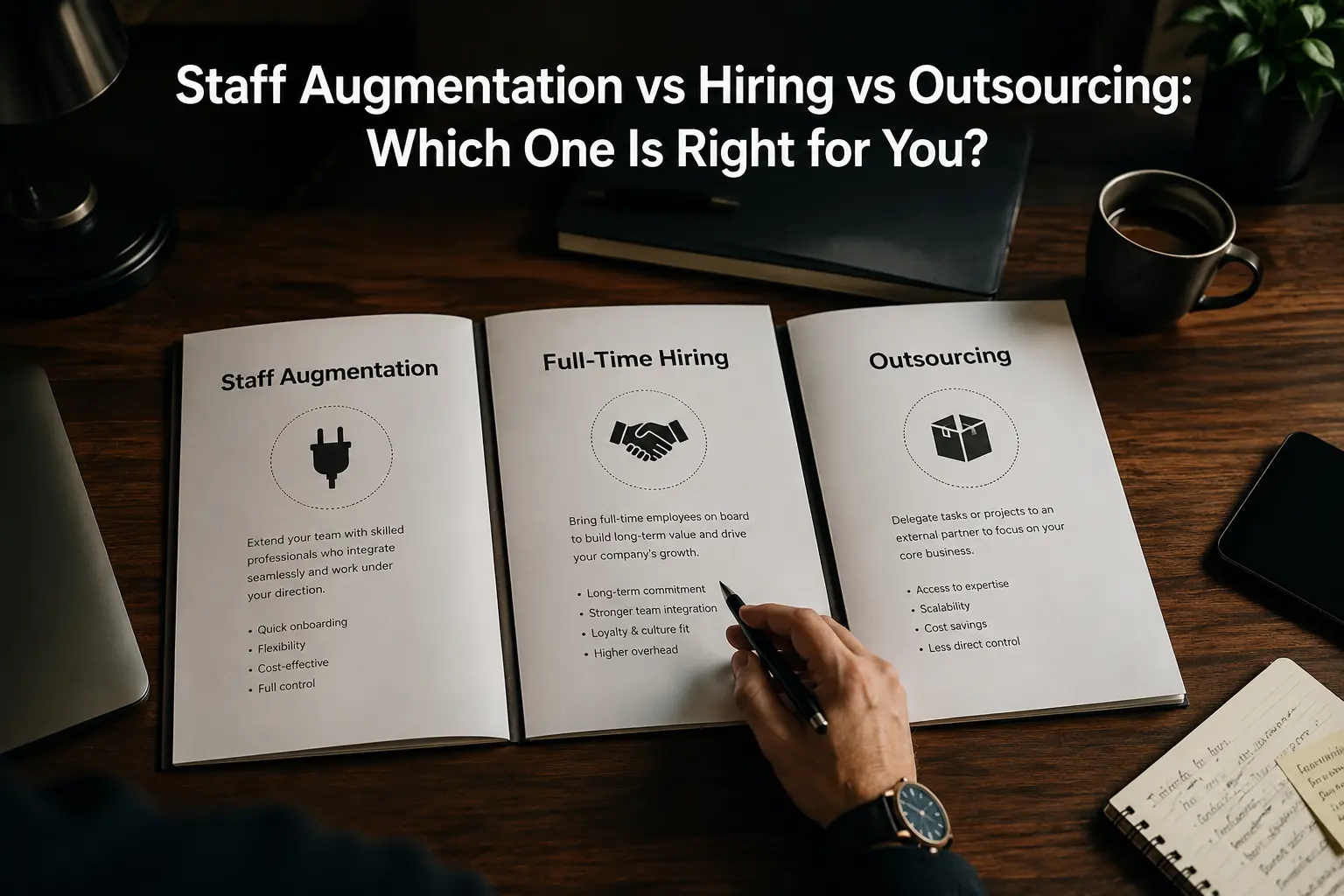
An Honest Comparative Guide for CTOs and Engineering Leaders
In the modern engineering landscape, the "war for talent" is no longer just a buzzword it is a daily operational reality. For a CTO, the challenge isn't just finding a developer; it's choosing the model of engagement that won't cripple the company's velocity or burn through the runway.
The choice between Staff Augmentation, Full-time Hiring, and Project Outsourcing is often framed as a cost-saving exercise. However, seasoned leaders know it is actually an exercise in risk management, knowledge retention, and architectural control.
1. Staff Augmentation: The Precision Scalpel
Staff augmentation is the practice of "borrowing" talent from an external provider to integrate directly into your existing team. They follow your processes, report to your managers, and use your tools.
📊 Key Metric: Industry data shows staff augmentation can reduce recruitment cycles from months to days, providing a 40–60% faster Time-to-Hire.
When It Makes Sense
- The Gap-Fill — You have a great team but lack a specific niche skill (e.g., a Senior DevOps Engineer for a migration).
- The Surge — You have a hard deadline for a product launch and need four more hands on deck for 6 months.
- Trial Runs — You want to test a developer's cultural and technical fit before committing to a permanent role.
The CTO's Honest Trade-off
You keep 100% control over the code and process, but you bear 100% of the management overhead. If the project fails, you can't blame the vendor you managed the people.
2. Traditional Hiring: The Foundation Stone
Full-time employees (FTEs) are the keepers of your "Tribal Knowledge." They are invested in the long-term health of the codebase and the company culture.
💸 The Hidden Cost of Hiring: Beyond base salary, a CTO must account for benefits, taxes, hardware, office space and the massive cost of a "Bad Hire," estimated by SHRM to be up to 3× the employee's annual salary.
Why CTOs Still Prioritize FTEs
- Cultural Alignment — Permanent staff care about technical debt because they are the ones who will have to fix it in three years.
- IP Security — While legal contracts protect IP in all models, internal loyalty is a stronger psychological barrier against leaks.
- Stability — External vendors rotate staff. Internal teams provide a consistent velocity that stakeholders love.
3. Outsourcing: The Turnkey Solution
Outsourcing (project-based) is when you hand over an entire outcome to a third party. They provide the project manager, the developers, the QA, and the final deliverable.
The "Outcome-First" Logic
This is best for non-core products. If you are a Fintech company, your core ledger must be built in-house. However, your marketing website or a secondary internal HR portal is a perfect candidate for outsourcing.
4. The Decision Matrix: Which One Do You Need?
📊 Factor Breakdown
Management:
- Staff Augmentation → Internal (Yours)
- Full-Time Hiring → Internal (Yours)
- Outsourcing → External (Vendor's)
Cost Type:
- Staff Augmentation → OpEx (Variable)
- Full-Time Hiring → CapEx/OpEx (Fixed)
- Outsourcing → Fixed Price / Milestone
Training:
- Staff Augmentation → Minimal (Pre-vetted)
- Full-Time Hiring → High (Onboarding)
- Outsourcing → Zero (Turnkey)
Flexibility:
- Staff Augmentation → Very High
- Full-Time Hiring → Low
- Outsourcing → Medium
Three Critical Pillars for Engineering Leaders
Pillar A: Core vs. Context
Is the work "Core" (the reason customers pay you) or "Context" (everything else)?
- Core → Hire or Augment
- Context → Outsource
Pillar B: The Duration Trap
Hiring for a 4-month project is a strategic mistake. By the time the developer is fully onboarded, the project is halfway done. Conversely, using Staff Augmentation for three years is usually more expensive than hiring — unless the local talent pool is non-existent.
5. The "Invisible" Hybrid Model
At UDaaann IT Solutions, we often see CTOs moving toward a hybrid approach. They maintain a lean core of internal "Architects" who own the vision, while using an "Invisible Development Team" (Staff Aug) to execute the build. This provides the agility of a startup with the stability of an enterprise.
💡 Pro Tip: Always ask your augmentation partner about their "Retention Rate." A vendor with high churn will kill your project velocity just as fast as a bad internal hire.
Conclusion
There is no single "best" model only the model that fits your current lifecycle.
- 🚀 Aggressive growth? → Augmentation is your bridge.
- 🏗️ Building forever infrastructure? → Hiring is your foundation.
- 🔧 Need a specific tool built without distracting your team? → Outsourcing is your lever.
Published by UDaaann IT Solutions : Engineering reliable, scalable digital ecosystems.