
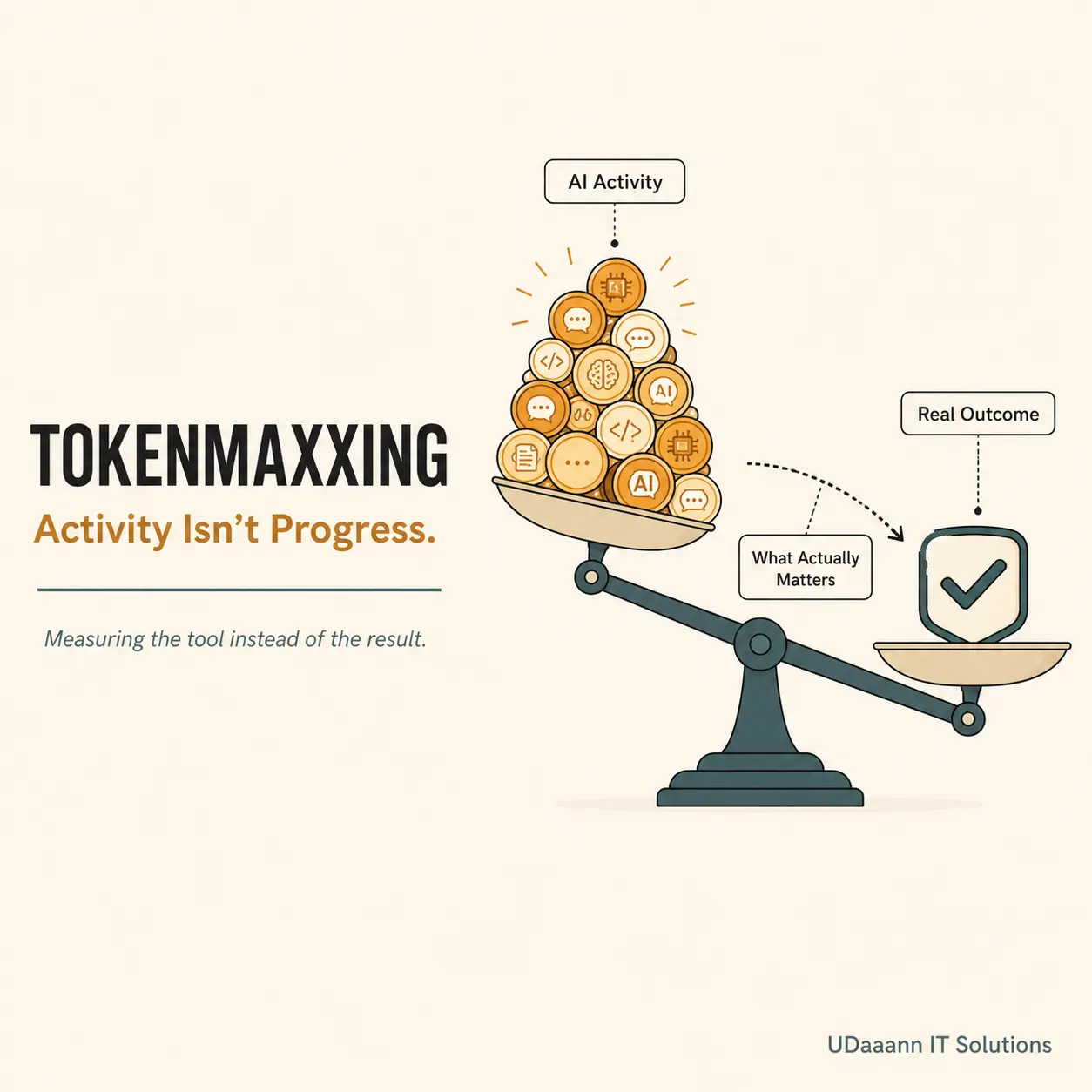
There's a new failure mode in software development, and it doesn't look like a bug. It looks like productivity.
We call it Tokenmaxxing: optimizing for how much AI got used on a project instead of what the project actually delivers. It's not a hypothetical. Uber reportedly burned through its annual AI coding budget in four months. Amazon had to formally tell engineers to stop using AI tools just to prove they were using AI tools. The pattern is the same everywhere it shows up: someone measured the wrong thing, and the wrong thing got optimized.
For a software agency, this isn't an interesting industry anecdote. It's a live risk on every project we take on. Here's how it actually shows up, and what we do differently.
What Tokenmaxxing Looks Like From the Client's Side
Most business owners will never see the word "tokenmaxxing" in a proposal. They'll see its symptoms instead:
- A quote that leads with tools, not outcomes. The pitch spends more time explaining which AI models will be used than what the finished software will actually do for the business.
- Deliverables that are hard to pin down. "We'll iterate using AI-assisted development" sounds efficient. It's often a placeholder for not having scoped the work properly.
- Invoices that scale with activity, not results. More prompts, more iterations, more "AI-powered" line items, none of which map to a feature the business asked for.
- A working demo that never quite becomes a working product. AI tools are extraordinary at getting to something that looks finished fast. They don't automatically get you to something that survives real users, real data, and a real Monday morning.
None of this requires bad intent. It's usually a measurement problem. When "AI usage" becomes the thing a team gets praised for internally, the software itself stops being the target.
Why This Matters More for Small and Mid-Sized Businesses
Large companies that fall into this trap absorb the cost and move on. A small or mid-sized business rarely has that cushion. A software budget that gets eaten by iteration instead of delivery isn't an inconvenience, it's a project that doesn't ship, or ships broken.
There's also a quieter cost: trust. Once a business has paid for "AI-powered development" that didn't produce anything usable, they become skeptical of every future vendor, including the ones doing it right. That skepticism is expensive for the whole industry, not just the business that got burned.
How We Handle It on Our End
We use AI tools throughout our development process. That's not the part we're cautious about. The caution is in how we scope, measure, and bill for the work around them.
- We scope to outcomes before any tool gets chosen.
Every project starts with a plain-language definition of what "done" means, written before we decide how AI or any other tool fits into getting there. If a deliverable can't be described without mentioning the tool used to build it, it usually means the deliverable itself isn't clear yet.
- We treat AI-assisted output as a draft, not a delivery.
A prototype generated quickly is a genuinely useful starting point. It is not the same as production-ready software. Every AI-assisted component still goes through the same review, testing, and integration process as anything written manually, because a demo looking right and a system behaving correctly under real conditions are two different bars.
- We bill for what gets delivered, not for how much AI touched it.
Our estimates are tied to features, milestones, and outcomes agreed on upfront. A faster path to a working feature through AI-assisted development is a win we pass on through timeline, not an excuse to pad the invoice with iteration.
- We keep a human owner on every architectural decision.
AI tools are good at generating code. They're not accountable for the decisions that determine whether that code is still maintainable in two years. Every structural choice, how systems connect, how data is modeled, what gets built now versus later, goes through a person who owns that decision and can explain it.
- We say no to vague scopes, even when they'd be easy to accept.
The easiest way to fall into tokenmaxxing is to accept a fuzzy brief and let the tooling fill in the gaps through endless iteration. We'd rather spend an extra hour scoping properly upfront than bill a client for us figuring things out on their clock.
Tips If You're Evaluating a Software Partner in the AI Era
You don't need to be technical to spot the warning signs. A few questions go a long way:
- Ask what you're actually getting, not what tools will be used to get it. A good answer describes features and outcomes. A vague answer leans heavily on the tooling itself.
- Ask how the invoice is structured. Milestone- and feature-based billing keeps incentives aligned. Time-and-activity billing with no clear deliverables is where tokenmaxxing tends to live.
- Ask what happens after the demo. A working prototype is not a working product. Ask specifically what testing, security review, and real-world load handling looks like before launch.
- Ask who's accountable for the architecture. If the honest answer is "the AI suggested it," that's worth a follow-up question.
- Notice how fast "yes" comes. A partner who immediately agrees to everything in a vague brief isn't being agreeable, they're often planning to figure it out later, on your dime.
The Bottom Line
AI didn't create this problem. Bad measurement did, and it's been around long before language models existed. What AI did was make it possible to generate a lot of activity very quickly, which makes the old mistake of confusing activity with progress easier to make and harder to notice, at least until the invoice arrives.
At UDaaann IT Solutions, we don't treat AI as the headline of a project. We treat it as one tool among several, useful exactly where it's useful, and never the excuse for skipping the parts of software development that actually make a system reliable.
Burn fewer tokens. Ship fewer excuses. Measure the thing that was actually supposed to happen.
Want a second opinion on a software quote or proposal you've already received? We're happy to take a look and tell you honestly what we see.