
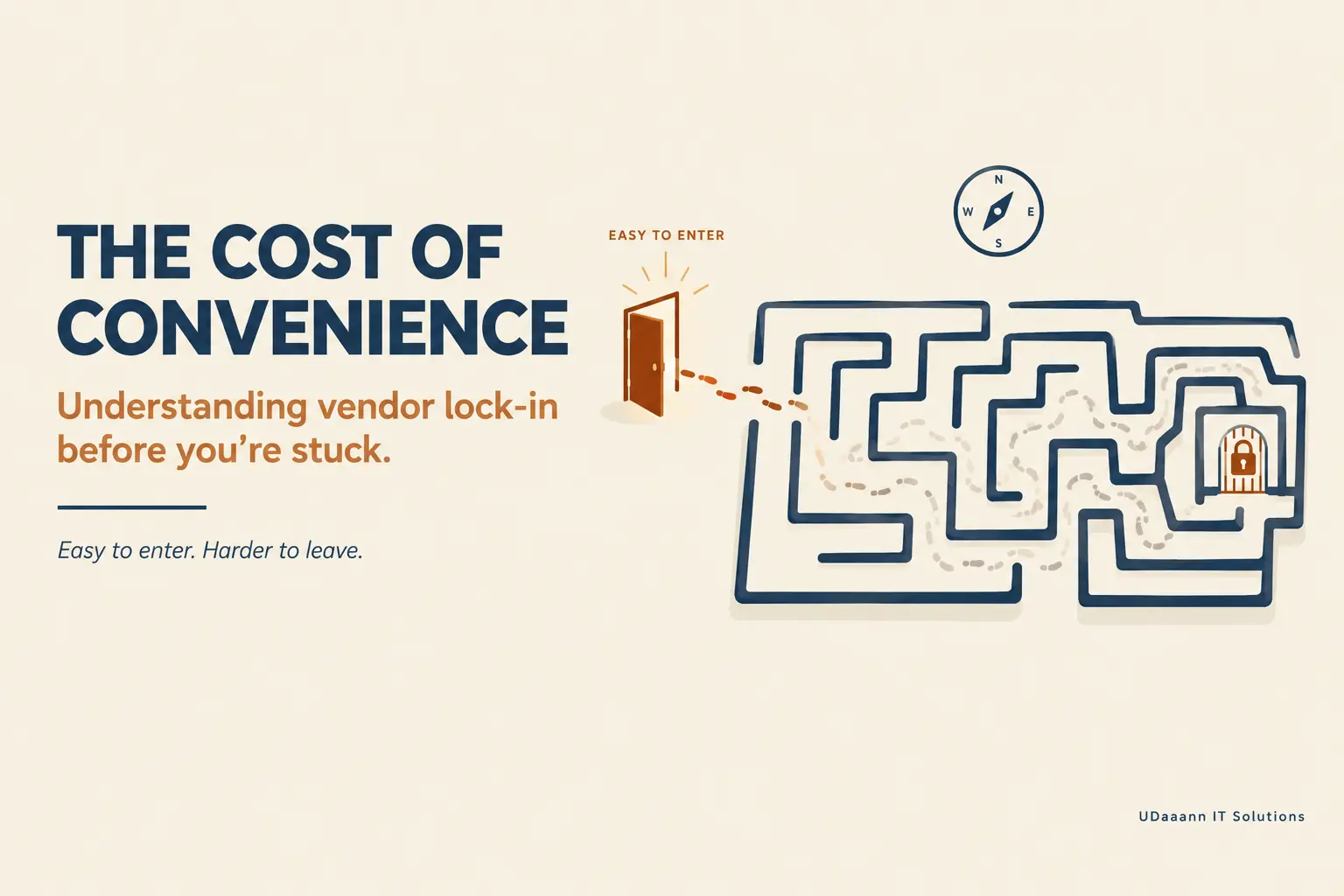
Every growing business eventually signs up for a tool that solves an immediate problem beautifully. It's fast to set up, the free tier covers what's needed today, and the team is genuinely relieved to have it. Nobody in that moment is thinking about what happens in three years if the pricing changes, the company gets acquired, or the business simply outgrows what that tool was ever built to do. That's exactly how vendor lock-in happens, not through a single bad decision, but through a series of individually reasonable ones that quietly narrow a business's options over time.
This is a genuinely current problem, not a theoretical one. As more businesses build their operations around a growing stack of specialized SaaS tools, and as consolidation continues across the software industry, the practical cost of being locked into a vendor's roadmap, pricing, and priorities has become a real strategic risk, not just an engineering inconvenience.
What Lock-In Actually Looks Like in Practice
Vendor lock-in rarely announces itself. It builds gradually, through a set of small, individually sensible decisions that compound into a genuine constraint.
Data trapped in a proprietary format. A tool that makes it easy to get data in and difficult to get it out isn't necessarily acting maliciously, export functionality is often just a low priority for a vendor focused on new feature development. The effect on the business using it is the same either way: switching later becomes expensive and risky.
Business logic embedded in someone else's platform. The longer a company builds custom workflows, automations, and integrations directly inside a third-party tool's ecosystem, the more that business logic becomes dependent on that specific platform's continued existence, pricing, and feature set, rather than living independently.
Pricing that scales unpredictably with growth. Many tools price attractively at small scale and become significantly more expensive as a business grows into higher usage tiers, precisely the point at which switching also becomes hardest, because the business now depends on the tool more, not less.
Integration debt. Every other system that gets connected to a locked-in tool inherits some of that same dependency. A CRM, an accounting system, and a support platform that all assume one particular tool will always be there create a web of assumptions that becomes genuinely difficult to unwind later.
Why This Deserves More Attention Right Now
A few current trends make this a more pressing consideration than it might have been several years ago.
Software consolidation is accelerating. Acquisitions, especially of smaller, specialized tools by larger platforms, happen regularly, and the acquiring company's roadmap doesn't always align with why a business originally chose that tool. A dependency that felt stable can change ownership, direction, or pricing with very little warning.
AI-powered tools are attracting rapid, sometimes premature adoption. Businesses are moving quickly to adopt AI-enabled platforms, often before fully evaluating switching costs, data portability, or long-term pricing structure, precisely because the immediate capability feels too valuable to pass up. That urgency is understandable. It's also exactly the condition under which lock-in tends to form fastest.
Subscription pricing models increasingly reward long-term commitment over flexibility. Multi-year contracts, escalating usage tiers, and bundled feature sets are increasingly structured to make switching costly by design, not as an accident of how the product evolved.
A Practical Framework for Evaluating Lock-In Risk
None of this is an argument against using third-party tools. Most businesses genuinely benefit from not building everything themselves. It's an argument for evaluating that trade-off deliberately, rather than by default.
Ask about data portability before signing up, not after wanting to leave. Can you export everything, in a usable, standard format, on your own, without needing a favor from support? If the honest answer is unclear, that's worth treating as a real answer.
Separate what lives inside the tool from what lives in your own systems. Where possible, keep core business logic, the rules that actually define how your business operates, in systems you control, using the third-party tool as an interface or accelerator rather than the permanent home for that logic.
Model pricing at a larger scale before committing at a small one. A tool that's inexpensive today should be evaluated against what it will cost at double or five times your current usage, since that's the scale at which you'll actually be locked in most tightly.
Build integrations with an abstraction layer in mind. Where a business genuinely depends on a third-party service, a thin layer of custom code between that service and the rest of the system can make a future swap dramatically less disruptive, even if that swap never actually happens.
How We Approach This With Clients
We treat vendor selection as an architectural decision, not just a procurement one. Before recommending any third-party platform as a core dependency, we evaluate its data export capabilities, its pricing trajectory at realistic future scale, and how cleanly it could be replaced if circumstances changed. Where a client's business logic genuinely needs to live somewhere, we default toward systems they own rather than systems they rent, using third-party tools deliberately for what they're genuinely best at, not as the default home for everything.
This isn't about avoiding SaaS tools or insisting everything be custom-built, that would be its own kind of poor judgment, trading one risk for a different, often worse one. It's about making the trade-off consciously, with a real understanding of what convenience today might cost in flexibility later.
The Bottom Line
Vendor lock-in isn't a mistake most businesses make on purpose. It's the quiet accumulation of individually reasonable decisions, made under real time pressure, without anyone stepping back to ask what the combined effect will be in a few years. The businesses that avoid getting stuck aren't the ones who refuse every convenient tool. They're the ones who ask the portability and pricing questions upfront, while the answer still doesn't matter very much, rather than discovering the answer later, at the exact moment it matters most.
At UDaaann IT Solutions, that evaluation is part of how we scope every project involving third-party dependencies, because the easiest tool to adopt today shouldn't quietly become the hardest one to leave tomorrow.
Not sure how locked into your current tools your business actually is? We're happy to take an honest look.